Russia bullies BP - U.S. motorist, take noteHow the aggressive behavior of the world's second largest exporter could drive prices higher for everyone.NEW YORK (CNNMoney.com) -- Russia is again flexing its energy muscle. On Friday, reports said Russia may cancel a contract it has with BP to develop a huge natural gas field in the middle of the country, claiming BP wasn't producing enough gas at the project.
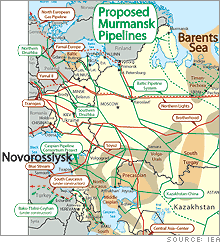
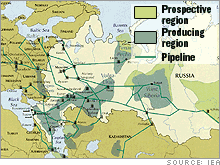
This would be the latest in a string of incidents generally interpreted as Russia strong-arming its partners into deals more favorable to the government. These moves, analysts say, could hurt worldwide production and drive up energy costs for consumers everywhere. Earlier this winter, the Kremlin shut off gas supplies to Europe after a dispute with Belarus, through which the pipeline passes. That dustup echoed a similar spat with Ukraine the previous winter. As evidenced by Friday's BP (Charts) news, private oil companies have also felt the Kremlin's wrath. In December, a consortium led by Royal Dutch Shell (Charts) agreed to sell its majority stake in the $20 billion Sakhalin II project off eastern Siberia to Gazprom, Russia's state-controlled natural gas firm, after facing heightened scrutiny from Russian regulators that many saw as politically motivated. The French energy company Total (Charts) has run into a similar problem with a project near the Barents Sea. And then there's the Yukos affair. In October 2003, the head of the giant private energy company was arrested and eventually jailed for tax evasion, though most observers say his real crime was challenging the political power of Russian President Vladimir Putin. Most of Yukos' assets have since gone to state-controlled oil company Rosneft, at what many said was a considerable discount. "The [Russian] government has become much more empowered by high oil prices," said Andrew Neff, a senior energy analyst at the consultancy Global Insight. "They see that control and access to energy is their key to a seat at the top table" of the world's most powerful nations. The stakes are high. Russia is the world's second largest oil exporter, at 9.6 million barrels per day, and accounts for over 10 percent of total world production. That makes it the world's second largest producer behind Saudi Arabia's 11.1 million bpd. Some years, when the Saudis undergo OPEC-mandated production cuts, Russia is number one. And its natural gas reserves are the largest on earth, nearly double that of No. 2 Iran. Yet most analysts see little danger of Russia shutting off its energy exports for any length of time. Indeed, up to a quarter of the country's gross domestic product is tied to energy, according to the Energy Information Administration. "It's not like Russia does whatever it wants to," said Denis Maslov, an analyst covering Europe and Eurasia for the Eurasia Group, a political risk consultancy. "It does rely on selling its energy to sustain its budget." As much as Russia may be a problem, the countries that surround it - and through which its energy shipments must pass - also pose obstacles. One analyst earlier this week blamed the Belarus disruption on the Belarussian government, which imposed a tariff on Russian oil and was then accused of stealing it after Russia tried to eliminate subsidies on Belarus' natural gas. "They just cannot blackmail Russia and Western Europe," said Fadel Gheit, an energy analyst at Oppenheimer. "Who said they are entitled to a discount?" But getting Russian oil and gas out of the country without going through politically dicey regions is a challenge. A pipeline is being constructed across Siberia to the Pacific, but its completion is being hindered by political snags with the Chinese and Japanese, who each want the pipeline to end in or near their country. Other ideas floated include pipelines to the Arctic town of Murmansk, where crude or, more likely, liquefied natural gas could be put on ships and sent to North America. Piping more to the Black Sea town of Novorossiysk is also a possibility, where it could then be sent by ship to Europe or Asia, though passage through the crowded Bosphorus Strait in Turkey is a headache. And sending oil by ship to Europe might be more expensive than sending it by pipeline, a cost that will ultimately be shouldered by the consumer. Driving away dollars While a complete or even lengthy partial energy shutoff on the part of Russia isn't likely, experts say that the country's recent tactics have soured Western oil companies on investing in the country. And that's not good for the global market, since Western oil companies are often cited for their technical expertise, which might help bring more Russian product to market at a cheaper cost. Neff cited Exxon's (Charts, Fortune 500) recent experience in the country, where it spent $60 million exploring off Eastern Siberia only to find that it didn't get first dibs when the time came to bid on production - contrary to how most exploration contracts work. "The producers say there's too much risk in this situation." he said. Indeed, Western companies are scrambling to find new deposits in a world fast running low on giant, new, easily accessible fields. "[These conditions] definitely pose a problem for the majors that want to play over there," said Neal Dingmann, a senior energy analyst at Dahlman Rose & Co., a New York-based energy investment boutique. "Particularly when they are reporting production that is down." But providing foreign oil companies, or Western motorists for that matter, with less risk may not be one of Russia's top priorities. After all, many of the contracts Russia signed with foreign oil firms were in the mid-1990s, when oil prices were cheap and Russia was desperate for foreign investment. "What's become somewhat apparent over the years is this idea that what's good for world markets isn't necessarily good for Russia," said Neff. "The fact of the matter is the Russians want to control foreign investment, and aren't nearly as concerned with X amount of oil coming from Russia to meet U.S. demand." That dynamic, Neff says, is something Westerners should get used to. "More and more oil is going to come from politically unstable countries," he said. "Either accept the fears and deal with it, or do something to limit demand." This story is an update to a January 12 filing |
Sponsors
|