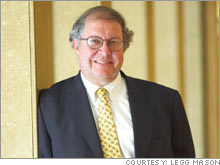
Bill Miller: What's luck got to do with it?For 15 years, legendary fund manager Bill Miller has been a walking counterargument to index funds. But could anyone ever hope to find the next Bill Miller? He thinks so. (Money Magazine) -- The streak may be over, but Bill Miller remains the iconic fund manager of his generation. As manager of Legg Mason Value Trust, he beat the market for 15 years in a row until his run ended last year. If you had invested $10,000 in Miller's fund in 1990, you would have $92,033 today.
With suits so rumpled they can resemble pajamas, Miller pays no attention to style. He shows the same contempt for convention when he invests. While most value investors refuse to buy technology stocks, Miller has made a killing on Amazon (Charts, Fortune 500), AOL, Dell and eBay (Charts, Fortune 500). A former graduate student in philosophy who earlier served as a military intelligence officer, Miller probably has the most original mind in the investing business. Money Magazine's Jason Zweig caught up with him recently. See the full transcript here. Question: How do you explain your performance streak? Most managers think they owe their success to skill, while most economists say it's nothing but dumb luck. A. I would explain it as a large degree of luck and maybe some modicum of skill - and by skill I mean just surviving in markets over long periods of time without blowing yourself up. You don't expect somebody who's never picked up a basketball to have the same free throw shooting record as a pro. Question: But even in the pros there are some mediocre players who temporarily look like superstars. A. Of course, anyone can get lucky for a short period of time. But consistent outperformance over long periods is probably evidence of skill. Otherwise, what would skill be? Question: Why shouldn't investors just put their money in index funds instead of trying to find the next Bill Miller? A. The odds of getting a manager who can outperform over 10, 15 or 20 years are about one in four. So there's a very significant case to be made for having most of your money in index funds. The fact is, however, that index funds do not give you the results of the index. They give you the results of the index less your costs, which are small but real. To have a prayer of outperforming, you've got to have some money in active management. Question: Can individual investors identify a great fund manager before he builds his track record? A. Start by looking for a long-term orientation. Portfolio turnover of 50% or less makes sense. [Turnover of 50% means the fund holds its typical stock for two years, nearly twice as long as the average.] Look for somebody who thinks about the price they're paying in relation to what this thing is worth. Intellectual curiosity, adaptability and flexibility are traits I'd like to see. Question: How can an outsider figure those things out? A. You can learn a lot by reading money managers' letters to shareholders. When they are interviewed in the press, that also gives you a sense of how they think. Question: I have a theory that great investors are not unemotional but inversely emotional: worried when the market is making people happy and feeling good when everyone else is worried. Do you see that in yourself? A. Definitely. I'm always much happier when stocks are trading at their 52-week lows. It's simple: Stock prices change more rapidly than business value. And rising stock prices mean lower future rates of return, while falling prices mean higher returns. Question: What do you foresee for stocks? A. I remain quite bullish. We think both Google and Yahoo are attractive. And I like airlines; they are one of the market's worst long-term-performing industries, but they are generating huge amounts of cash and could surprise people. Question: You've often said, "The guy with the lowest average cost wins." What do you mean? A. Most people are not wired to sell what's going up and buy what's going down. It hurts. But your profit is the difference between your average purchase price and your average selling price. Bernard Baruch [a great investor in the 1920s] said nobody buys at the bottom and sells at the top except liars. Your stock will go down after you buy it, and it will go up after you sell it. Being willing to lower your average cost [by buying more when a stock drops] is a great strategy. But it's difficult. Minds over Money: In honor of Money Magazine's 35th anniversary, we're running special interviews with the smartest thinkers we've come across in three-plus decades. John Rogers: Buy. Hold. Profit. Give back. Bill Sharpe: The man who explained it all Robert Shiller: Mr. Worst-case scenario Jack Bogle: Still scolding after all these years Olivia Mitchell: Scholar of the boomers' future Ralph Wanger: Winning the home run hitter's game Charles Schwab: The smartest way to invest |
| |||||||||