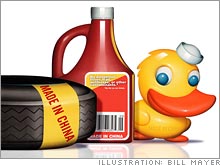
Is sourcing in China worth it?Businesses weigh the costs and benefits, in the wake of product recalls and bans. (FSB) -- When Amber McCrocklin launched Paws Aboard, she followed a pattern familiar to thousands of small-business owners. McCrocklin, now 35, had created a line of gear for pet owners who like to take their dogs on their boats. She started by handcrafting boat ladders, life jackets, and waterproof leashes with the help of a local engineer. When the orders began pouring in, McCrocklin decided to shift operations to China, which could trim costs by half and give her time to design more products to expand Paws Aboard (pawsaboard.com). On the recommendation of another Indianapolis business owner, she hired an engineer in Shenzhen to redesign the products for mass production and let him find a factory to do the work. "It worked for the guy who recommended it, so I wasn't really worried," she says. She immediately cranked up production fivefold and saw her profit margin double. Then the problems started. The clasps on her life jackets were breaking, the shipments were late, her contact in China was unresponsive. McCrocklin's patience finally expired when she opened a container of 3,000 leashes-all defective. "The colors were completely reversed, and the logos were all upside down," she says. The factory would not make good on the order, and McCrocklin didn't want her clients, retailers and online stores, to see the shoddy work. "I'm not sure if I'll ever be able to sell these," she says. A bad batch of leashes may seem trivial compared with the potentially deadly output of Chinese factories that has paraded across the headlines-including 1.5 million toy trains coated with lead paint and 60 million containers of toxic pet food. In July the Food and Drug Administration banned shrimp and four species of contaminated farm-raised fish from China. Suddenly, outsourcing to China-standard procedure for thousands of entrepreneurs-looks a lot more complicated. Now businesses must factor in the true cost of obtaining their products at the world-beating "China price." After the recalls, says Andrew Bartolini, an expert on global sourcing at Aberdeen Group, a research firm in Boston (aberdeen.com), "there's an understanding that low costs come with risks." Even big companies have trouble dealing with the fallout from defective products-unsellable goods, bad publicity, recalls, crippling litigation. Menu Foods, a $303-million-a-year company with more than 1,000 employees, spent $38 million recalling melamine-tainted pet food. Foreign Tire Sales, a 13-employee importer based in Union, N.J., says it faces a $90 million pricetag for its recall-and possible bankruptcy. The company, which sold only 700,000 tires last year, must replace 450,000 made by the Hangzhou Rubber Co. that may have dangerous defects. The cloud over Chinese goods does have a silver lining. Some Americans are shopping harder for goods that say MADE IN THE U.S.A. And the nightmare scenario playing out at places such as FTS has alerted business owners to be more aggressive in managing their Chinese connections. They must imitate the ways in which multinationals control supply chains, says Bill Primosch, senior director of international-business policy at the National Association of Manufacturers (nam.org). Unlike big companies, most entrepreneurs can't afford to put employees on the ground to watch the assembly line. But a growing cottage industry of consultants specializes in managing overseas manufacturing contracts, says Bartolini. Many will help find a sourcing partner. Others can inspect goods at the factory and arrange shipping. Some handle everything, from selecting an industrial designer to overseeing quality control, even assuming liability for a factory's output. Sourcing consultants earn their income by marking up products, but the client can still come out ahead because these sophisticated players have connections to factories that other consultants and brokers don't, says Bartolini. As with Chinese sourcing partners, the quality of middlemen varies. "There are a lot of cowboys-lone brokers with websites-some of whom have never even been to China," says Christopher Devereaux, managing director of China Savvy (chinasavvy.com), a sourcing company based in Hong Kong. To find reliable middlemen, Devereaux says, check with other importers and trade associations in your industry. McCrocklin of Paws Aboard found her new consultant, One World Sourcing (oneworldsourcing.com), at a local trade show. One World, based in Brooklyn Heights, Ohio, took over the manufacturing, quality control, and shipping of McCrocklin's dog gear last summer. Her defect-driven headaches faded, and profits have improved: "My costs dropped another 30% with the factory they hired," she says. "I get more done, at a more reasonable price-and I don't receive late-night phone calls from China anymore." |
Sponsors
|