
Three great ways to mess up your 401(k)Don't look now, but you may be draining thousands from your savings with these costly errors. NEW YORK (Money Magazine) -- What's worse than approaching retirement with too little money because you didn't contribute enough to your 401(k)? How about saving diligently but sabotaging your effort because you've made poor investing decisions? Recent research from Financial Engines, an online advice service, suggests many people are doing just that. 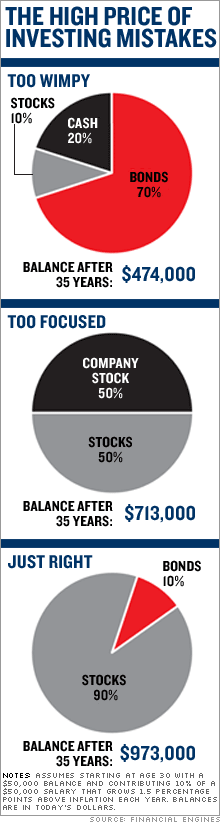 In a study of 100,000 401(k) participants, the company found that 70 percent gave up returns of one to three percentage points a year after inflation because of common and entirely avoidable blunders. The cost: potentially hundreds of thousands of dollars over the course of a career. Don't repeat their mistakes. Ask yourself if you're guilty of the following: Loading up on company stock Company stock remains the single largest holding in 401(k) plans that offer it as an option, Hewitt Associates reports. In fact, one in five people hold half or more of their balance in company stock. "People view their employer's shares as less risky because they feel they know their company," says Pamela Hess, Hewitt's director of retirement research. But a single stock is typically two to three times as risky as a diversified portfolio, without offering any reasonable expectation of a commensurately higher return. Just ask the employees of Enron, who lost everything. If you own any company stock in your 401(k), sell it. If you can't bring yourself to do that, at least limit it to 10 percent of your portfolio. Under a law passed last year, you can even sell shares that your employer contributed to your account, as long as you've been there for three years. Being too conservative Plowing too much money into low-risk choices like stable value, bond and money funds may seem safe since it protects your 401(k) from market setbacks. But it's dangerous in the long run because your savings won't grow enough to provide you with an adequate income in retirement. A better approach: Create a blend of stocks and bonds that provides a cushion against price drops but also gives you a shot at the gains you'll need to amass a sizable nest egg. For help setting the appropriate mix for your age, check our Asset Allocator tool. Doin' the smorgasbord thing In an attempt to diversify, some people spread their money evenly across all the options on their 401(k) menu. That doesn't produce a well-rounded portfolio any more than scarfing every item at a buffet assures a balanced meal. You might wind up with too big a helping of growth or bonds, depending on your plan's options. What to do? First plug your choices into the Instant X-Ray tool at morningstar.com to see how your portfolio breaks down by the major asset classes - large and small stocks, bonds and foreign shares. You can then compare your current mix to the blend our Asset Allocator recommends and, if necessary, rejigger your choices to get your 401(k) on track. Avoiding these errors won't guarantee you a giant nest egg. But you will be making the most of every penny you set aside. And in the long run, that will pay off. |
| ||||


