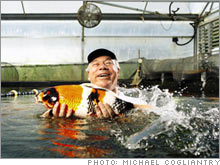
Breeding a $5,000 fishHow I turned my hobby of raising koi into a successful business Penns Grove, N.J. (FSB Magazine) -- I am the CEO of Parkway Corp., a Philadelphia company that operates 100 parking facilities in the U.S. My second business, breeding koi, started as a hobby. I bought about 40, to study what makes these beautiful fish so valuable. What is the best body shape? Is that brilliant red pattern going to disappear in six months, leaving the customer with an inferior fish? Many dealers base a koi's price on what it looks like today. We grade them according to what they'll look like over the years. I launched this operation in southern New Jersey in 2002. Most U.S. koi breeders sell to the mass market; I saw an opportunity to breed better-quality fish for serious hobbyists. Most U.S. dealers fly to Japan and buy everything but tategoi, the highest-quality koi. They are too expensive. A five-inch fish, which will live about 50 years, costs more than $1,400 wholesale. At Quality Koi (qualitykoi.com) we sell that same fish for less than $1,000. We breed 40 types of koi and sell 20,000 to 30,000 fish a year, 90% of which we sell wholesale to dealers. Their customers are hobbyists, who pay $15 to $5,000 a fish. Some have won prizes in fish shows against Japanese competitors. I've invested more in the farm than I ever thought I would. We expect to turn an operating profit at the end of this year, with revenues exceeding $500,000. We've had many surprises. Four years ago thousands of fish disappeared in one day. We tested the water and found nothing wrong. A Japanese consultant visited and told us, "You have to walk the ponds." With each step, you release methane trapped beneath the clay bottom. Unless you release the gas regularly, it can erupt with such force that it disintegrates the fish. After five years we're still learning how to run the farm. - As told to Caroline Tiger |
Sponsors
|