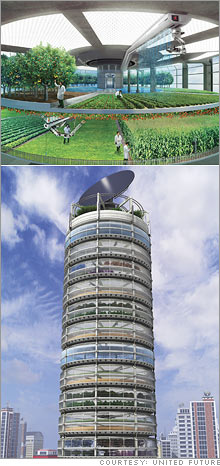
Farming goes verticalSkyscrapers may provide new source of farmland. (Business 2.0 magazine) -- The term "urban farming" may conjure up a community garden where locals grow a few heads of lettuce. But some academics envision something quite different for the increasingly hungry world of the 21st century: a vertical farm that will do for agriculture what the skyscraper did for office space. Build a 21-story circular greenhouse, says Dickson Despommier, an environmental science professor at Columbia University, and it can be as productive as 588 acres of land - growing, say, 12 million heads of lettuce a year.
With the world's population expected to increase by 3 billion by 2050 - nearly all of it in cities - and with 80 percent of available farmland already in use, Despommier sees a burgeoning need for such buildings. So he talked to fellow academics at the University of California at Davis about using rooftop solar panels to power 24-hour grow lights and found NASA-like technology that would capture evaporating water for irrigation. "We need to devote as much attention to vertical farming as we did to going to the moon," Despommier says. "It will free the world from having to worry where our next meal will come from." It should also turn a handsome profit. Despommier's calculations peg the construction cost of a 21-story vertical farm at about $84 million, operating costs at $5 million a year, and revenue at $18 million a year, based on the price of produce at upscale Manhattan delis. Getting product to market is one of the most expensive parts of traditional agriculture, but with a vertical farm, your retailers are just down the block. Despommier has been talking to VCs in both the United States and Europe. The Sustainable Agriculture Initiative, a group of 20 food companies including Coca-Cola (Charts, Fortune 500), Kraft (Charts), McDonald's (Charts, Fortune 500), and Nestl�, has expressed interest, as has IBM (Charts, Fortune 500). Kristin Reynolds, program representative at the University of California's Small Farms Program, says her only concern is that vertical farming could grow too big too fast: "It needs to be developed cautiously, so it doesn't take markets away from small-scale farmers." |
Sponsors
|