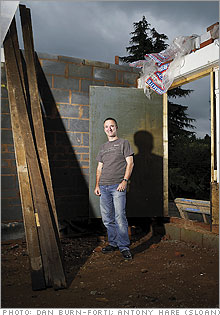
Web opportunist cuts out middlemenHow can you avoid the expense of third-party brokers? Throw up a website and pretend to be one yourself. (Business 2.0 Magazine) -- David Carter has a knack for discovering more offbeat approaches to making money. When I wrote about him for this column last year ("The Startup Facade," October 2006), he had just stumbled into the decidedly pre-Internet business of surveying buildings for asbestos. How? He had set up a simple website and within weeks amassed so many clients wanting surveys that he took the next step: he enrolled in a two-day course in surveying and started taking orders. This past year, Carter, 48, earned $250,000 as an eight-hour-per-week surveyor. Now he's at it again - using the Web to create another false front that pads his bank account. His strategy now, though, revolves around saving money. The gist: squeeze out the middlemen in home remodeling by using the Web to masquerade as one.
It all began when Carter started renovating his 1930s four-bedroom house on the outskirts of Birmingham, England. He wanted to install floor-to-ceiling glass doors in the back of the house, and after some research he settled on handmade doors built by a German company (which I agreed not to name). When he called the firm to get in touch with a local supplier, Carter was told there were none in the area and to choose a window installer who could place the order on his behalf. That was the lightbulb moment. "It was time to bring out the smoke and mirrors," Carter says with a chuckle. He took a domain name he'd already bought (new-windows.co.uk), tossed up a quick-and-dirty website, and - poof - instantly became a "unique window brokerage service." He listed a phone number manned by a vendor that, for $1.50 a pop, answers calls for "New Windows UK" and sends him a text message to call back. Carter fired off a note to the German manufacturer, requesting the wholesale price for the doors he wanted. After two attempts, a quote came back with a 45 percent discount. His total savings: $7,250. "The house is sucking up all my money at the moment," he says. "Wherever I can save, that's what I'll do." The doors are en route. Isn't it all a bit sleazy? Carter doesn't think so. "Who am I hurting?" he asks. He has a point: why should a window broker earn $7,250 for doing nothing but placing an order? The manufacturer makes the same money regardless. Moreover, Carter's website says he will charge a flat fee of $500 to measure and choose windows. So far, no one has taken him up on it - but "if someone asks, will you help me with my windows for 250 quid, I'd be a fool to say no," he says. "I've got a tape measure." Of course, applying Carter's methods to other services may not always work. Manufacturers often insist on some form of verification. So what's next? "I need a new roof," he says. "Whether I can pull that off, I don't know." Just in case, he's already got the domain: uk-roofing.com. |
Sponsors
|