
Big bailout: Where things stand
Federal officials and lawmakers will spend the weekend hammering out the details of what could be the biggest government bailout in history.





NEW YORK (CNNMoney.com) -- The federal government is on the verge of instituting the most sweeping intervention in the financial markets since the Great Depression.
Details remain scarce as the Bush administration and Congress work to hammer out the final plan, which is aimed at stemming the credit crisis that's roiling Wall Street and threatening the global markets.
The Bush administration sent its proposal to members of Congress overnight, according to White House spokesman Tony Fratto.
"Secretary Paulson and his team will continue their discussions with Congress and staff throughout the weekend, and we're hopeful that good progress will be made," Fratto said.
Here's what we know so far:
The plan: The federal government would buy up "hundreds of billions of dollars" of illiquid mortgage assets at a deep discount from banks. The Treasury Department is likely to run the program directly, unlike the savings and loan crisis of the 1990s that led to the creation of the Resolution Trust Company.
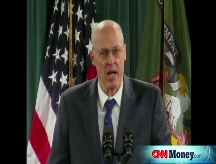
"The federal government must implement a program to remove these illiquid assets that are weighing down our financial institutions and threatening our economy," said Paulson.
In the proposal sent overnight, President Bush has asked Congress for the authority to spend as much as $700 billion to purchase troubled mortgage assets and contain the financial crisis.
President Bush said Saturday that the plan matches the scope of the problem.
"It is a big package because it's a big problem," he told reporters at a joint news conference with Alvaro Uribe, the president of Colombia.
What remains to be seen is how the Treasury Department will structure the purchases and what price they'll pay.
The cost: While the proposal calls for the purchase of as much as $700 billion of bad loans, it's unknown what taxpayers will ultimately pay for the bailout.
The administration's proposal requests that Congress authorize an increase to the nation's debt ceiling. Currently, it's set to rise to $10.6 trillion for fiscal year 2009 - which runs from October 2008 through September 2009. But the proposal requests that limit be increased to $11.315 trillion to allow for the purchases of mortgage-backed assets.
The government will likely buy the assets at below-market rates and hold onto them until the market recovers. Ideally, the loans could then be sold at a gain.
"The government could make a profit, a substantial profit," said Jaret Seiberg, a financial services analyst at the Stanford Group, a policy research firm. "The pricing mechanism is going to be central."
Will it work: The jury is still out, although experts are cautiously optimistic the plan will help the housing crisis.
The plan will help banks shore up their balance sheets by removing hard-to-value assets. This would address the seemingly endless rounds of writedowns and capital raising that have been rocking the financial sector.
Without these bad loans weighing on their books, banks may be more willing to lend. Or at least that's the goal.
The problem is that the bailout will not automatically make banks profitable, nor will it stop the slide in home values that is wreaking havoc on the economy.
Will it help homeowners: It's unclear at this point. If the government buys an entire securitized loan, it could opt to help struggling homeowners by modifying the terms. This could include reducing a loan's interest rate or principal balance.
But it could prove difficult to snap up all the securities sold on a mortgage, experts said. And as long as investors still hold a piece, they could block any changes to the loan.
If the plan doesn't stem the tide of foreclosures, home prices will not stabilize and the economy will not recover, experts said.
Next steps: Lawmakers have said they'll review the plan over the weekend and plan to hold hearings on the matter next week. A deal could be hammered out as soon as next week.
CNN Correspondent Kathleen Koch contributed to this report. 



