The next green fuel source: algae
Sapphire Energy has $100 million riding on its bet that we'll soon be filling up our tanks with algae oil.



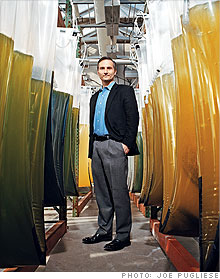 |
| Sapphire Energy founder Jason Pyle |


 |
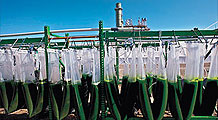
| Power plant: Sapphire's algae |
SAN DIEGO (Fortune Small Business) -- Step into the greenhouse at Sapphire Energy, a small biofuel company in San Diego, and you might expect to be accosted by rows of exotic tropical orchids or at least a few tomato plants. But the only thing growing here is algae - lots of it.
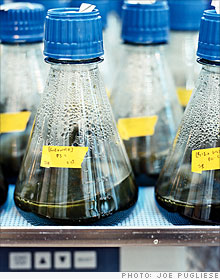
Inside 1,000-liter bags of salt water, each one bubbling with carbon dioxide, live some of the fastest-growing plants on earth: algae that have been genetically modified to produce an oil much like underground crude. If Sapphire can grow enough algae, the oil generated could replace petroleum and the organisms themselves could help save the planet by eating excess carbon dioxide in the atmosphere. Not bad for pond scum.
The concept of algae as fuel is not new. A federal energy project created in 1978 studied pond scum for nearly two decades. It examined 3,000 strains and concluded that algae with a high oil content and a taste for harsh living conditions just might help mankind kick its fossil fuel addiction.
Once popular with environmentalists, ethanol and biofuel made from vegetable oil have fallen out of favor, largely because they take more energy to make than they produce. But there's been a tiny bloom of algae startups in recent years. There are 60 of them in the U.S. today, according to the Algal Biomass Organization, 50 more than existed five years ago.
"All of them are small companies," says Thomas Byrne, the industry group's secretary. "And many right now just have a concept."
Sapphire is one of the most promising companies in its class. Founder and CEO Jason Pyle, 38, is a molecular biologist on his third startup (he also founded two medical technology companies in San Francisco). Pyle and his team started off in 2007 with about 40 strains of oil-producing algae and have since genetically engineered 100,000 strains. Their goal: to isolate strains that create lots of oil very quickly.
In September 2007, Sapphire found a winner - algae whose oil is molecularly similar to light, sweet crude. In other words, any refinery can take the algae oil, which looks a lot like molasses, and turn it into gasoline, jet fuel or diesel.
"I can't wait 20 years to build a new infrastructure for liquid fuel," says Pyle. "We want to use the pipelines, refineries and gas stations we have now and get our fuel into cars, trucks and airplanes."
The company tested its algae oil successfully on a Continental Airlines (CAL, Fortune 500) flight in January, but only as a 2% blend in a larger biofuel experiment. "We don't want to make an additive," Pyle says. "We want a swap": so-called "green crude" for regular crude.
The Continental flight was the first public demonstration of Sapphire's fuel. Tests with other large fuel customers are due this year and next. But Sapphire's business model requires massive scale. The company is currently building a test facility in Las Cruces, N.M., with 22 acres of ponds that will suck up salt water from an underground aquifer. Pyle hopes it will produce about seven barrels of oil a day. After that, he says, Sapphire plans to conduct a much larger demonstration project - 10,000 barrels per day, or half the production capacity of a large refinery.
Other than production, one major issue remains: separating the oil from the water in which it was grown. "Right now it takes a lot of energy to do that, which defeats the purpose," says Seth Snyder, a biochemical engineer at Argonne National Laboratory.
The company is not without competitors. Like Sapphire, Aurora Biofuels in San Francisco creates genetically modified algae, but rather than developing algae that yield the most crude-like oil, it focuses on strains that produce the most oil, period. In Maui, HR BioPetroleum has announced plans for an algae facility that will capture and eat carbon dioxide from the Hawaiian Electric power plant next door. At Solazyme, also in San Francisco, the algae are kept in the dark and fed a diet of switchgrass and sugarcane. Solazyme claims it has produced the first algae oil to meet aviation fuel standards, though it has yet to be tested in a plane.
Sapphire has plenty of admirers. Microsoft (MSFT, Fortune 500) founder Bill Gates is first among them: His private venture firm, Cascade Investment, helped Sapphire raise more than $100 million last July.
Other algae startups are cheering them on. "These are extremely big bets," says Aurora chairman Jim Long, "and $100 million is about the threshold. This really isn't about competition between algae companies; the competition is oil."
If Sapphire finds a secure economic environment where the company can grow quickly, everybody wins. The algae couldn't have put it better themselves. 

-
 The Cheesecake Factory created smaller portions to survive the downturn. Play
 -
 A breeder of award-winning marijuana seeds is following the money and heading to the U.S. More
 -
 Most small businesses die within five years, but Amish businesses have a survival rate north of 90%. More
 -
 The 10 most popular franchise brands over the past decade -- and their failure rates. More
 -
 These firms are the last left in America making iconic products now in their twilight. More