
Why the deficit will raise taxes
The nation's debt must be brought to heel, and doing so will require tough choices beyond spending cuts, experts say.




NEW YORK (CNNMoney.com) -- A $9 trillion federal deficit over 10 years may be too hard to comprehend. But this part is easy: Such unwieldy amounts of debt could have an impact on Americans' bottom line one way or the other -- if not tomorrow, then the day after.
The U.S. government has been spending a great deal more than it has been taking in, and it is on track to do so well beyond the next 10 years. It has been borrowing money to make all that spending possible and it has to pay the money back with interest. How, you ask? By borrowing more.
The solution is straightforward if unpleasant: Shy of finding a fairy willing to leave trillions under Uncle Sam's pillow, lawmakers will have to raise taxes and cut spending.
The more the country lives on a credit card, the more it makes itself beholden to the demands of its creditors -- many of which are overseas. The danger is that buyers of U.S. debt could become concerned that the country is running too high a balance. If so, they will demand higher interest rates -- thereby making the country's debt problem worse -- or they'll put their money elsewhere.
At that point, things would get ugly.
"Taxes would rise to levels that would make a Scandinavian revolt. And the government would not be able to provide anything but the most basic public services. We would no longer be a great power (or even a mediocre one), and the social safety net would evaporate," tax policy expert and Syracuse University professor Len Burman wrote in a recent op-ed cheerfully titled "Catastrophic Budget Failure."
That's why acting sooner rather than later makes sense. But acting too soon could cause its own set of problems since the economy is only beginning to lick its wounds from a punishing recession.
Economists and tax experts, no matter their ideological position, agree raising taxes when the economy is down is self-defeating.
But as the economy finds a solid footing, the hard choices will have to be made.
"We need to do this in stages at the right time," said David Walker, former U.S. comptroller general, in a CNNMoney.com video.
Right now there is a lot of talk, but not a lot of planning, about how to address the situation.
In fact, President Obama is pledging to keep taxes low for most people.
For example, Obama has proposed keeping in place the 2001 and 2003 tax cuts for families making less than $250,000 (under $200,000 for individuals). The cuts are scheduled to expire in 2011.
A number of temporary tax relief measures, including the patch to protect the middle class from the Alternative Minimum Tax, are set to expire even sooner. And Obama has said he would like to keep many of those measures in place as well.
Experts say that's not going to cut it.
"Taxes are going up and they're going up for a lot more people than those making more than $250,000. Why? Math. The numbers don't come close to working," Walker said.
For instance, the president's proposal to raise taxes only on high-income families would raise an additional $600 billion over 10 years, said Roberton Williams, a senior fellow at the nonpartisan Tax Policy Center.
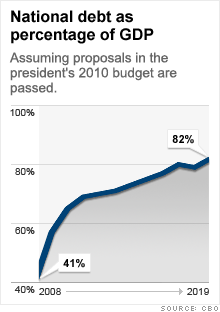
That's not a lot when the government is staring at a 10-year deficit of $9 trillion. A 10-year deficit of that magnitude means the debt held by the public -- the accumulation of all annual deficits over the decades -- would reach 82% of gross domestic product come 2019. That's double the 41% recorded in 2008.
When lawmakers do decide to act, they will need to do more than just tinker with tax rates, according to Williams.
Tax experts have been calling for fundamental tax reform to make the system less complex. Plus, Williams said, Congress will likely need to seek out a new source of revenue beyond the income tax. One idea that has been talked about increasingly is a value-added tax, which is a tax on goods and services at every stage of production up to the point of sale.
A multi-pronged approach may work best because "no piece by itself is enough," Williams said. "There's a really big hole to fill and [lawmakers] are just talking about dollops." 



