
Market is back to normal. Now what?
Stocks have erased much of last year's losses. But while the worst may be over, many of last year's problems haven't gone away.




NEW YORK (CNNMoney.com) -- I have to admit it's getting better. A little better all the time.
Yup, I've succumbed to the latest round of Beatlemania -- don't the digitally rendered lads from Liverpool look fab in "Rock Band"? -- but so have investors. And Wall Street has been acting more like cheery, optimistic Paul than brooding cynic John over the past few months.
Stocks have continued to rally even though the economy still faces some notable challenges, such as rising unemployment and foreclosures, as well as worries about the ballooning budget deficit and weakening dollar.
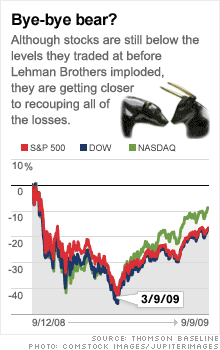
Many bulls argue that the explosive rally -- the S&P 500 is up more than 50% since March -- is justified because of how far the market plunged during the height of the financial panic. The S&P 500 plummeted 46% between Sept. 12 and March 9 of this year.
This is a great point. Stocks were oversold earlier this year on what turned out to be overblown fears of a massive wave of bank nationalizations, the end of capitalism and another Great Depression.
"Companies have been very good at cutting costs and managing their businesses in a difficult environment. Looking forward, you can see a recovery in the economy and earnings," said Mark Phelps, CEO of W.P. Stewart & Co., an investment firm in New York. "The world is a better place than it was a year ago, which is nice to see."
And as more evidence mounts that the worst may really be over, the bounce seems to simply be an acknowledgment that better times lie ahead.
"The markets always respond before recessions end. It's fairly obvious that the recession is reaching a bottom," said Jerry Goss, a managing director with Wells Fargo Advisors in Baton Rouge, La., who oversees $350 million in assets. "Several months or quarters from now, the economy will be growing and stocks, as they've always done, are anticipating that."
But the rally has now run so far in such a short period of time, it's getting harder to dismiss the bearish argument that stocks are overdue for another correction.
Consider this. Tech stocks have almost completely recovered their bear market losses. The Nasdaq is just 9% lower than where it was on Sept. 12. The Dow and S&P have also taken a big step back from the abyss: They are now only about 16% below their pre-Lehman levels.
So with each day and week that the markets head higher, stocks are getting even closer to erasing all of the declines from last September through March.
And as someone who considers himself neither a wild-eyed optimist nor a gloom-and-doom pessimist, I'm not sure that it's fair to say just yet that the markets and economy are healthy. That means investors need to be wary, although not necessarily downright bearish.
Yes, this looks like a nascent recovery. But investors may be pricing in a so-called V-shaped recovery, one where the economy charges ahead almost as quickly and sharply as it fell off a cliff.
Such a scenario could unfold if consumers started spending again. But consumers are saving more and paring back their debt levels.
Part of this has to do with the fact that banks are still reluctant to lend. But it also seems that many Americans have actually learned a valuable lesson from this recession. Irresponsible use of credit is a bad thing.
This is good news for the long-term health of the economy but it will likely mean that a recovery won't be as robust as some expect.
So instead of a V, some experts are now talking about a so-called square root recovery (fitting for yesterday's 09/09/09 date). That means the economy could recover quickly and then flatten out, which would like a square root sign.
"Investors have the right to be cautious. Two big issues are lurking on the horizon that are still unresolved: just what contribution the consumer will make to the recovery and how robust corporate revenue growth will be," said David Joy, chief market strategist with RiverSource Investments, a money management firm based in Minneapolis.
Joy said he's not overly worried because he thinks that stocks are now fairly valued as opposed to overvalued. And with the S&P 500 trading at about 15 times 2010 earnings estimates, he appears to be right.
Still, fairly valued isn't the same thing as cheap. Many of the bargains are probably gone now that a lot of the easy money has been made.
Phelps said that it will be tougher for the broader market to move higher since investors will be looking more for concrete evidence of a recovery, and not just improvement in sentiment.
"The rally has been reasonably sensible, but from a valuation perspective we've gone about as far as we've should go," he said. "That's not to say stocks won't go higher. But the market is going to move more on a company by company basis going forward."
And momentum has a habit of changing on a dime. If more questions about the recovery and valuations lead to a sell-off anytime soon, investors would be wise to not get caught flat-footed.
Goss said he'd be "surprised and disappointed" if stocks fell back toward the March lows. But, he added, that investors can't stubbornly stick to one type of strategy. The events of last year should have taught us all that.
"Investors should be adaptive and flexible. They need to be willing to make more tactical adjustments as conditions and markets change," he said. "People have to realize that there is more to the market than U.S. stocks. Foreign stocks, bonds, commodities, currencies and even cash are all good investments."
Talkback: Was the financial crisis of last year a good wake-up call for investors and consumers? Or has nothing really changed since last September? Share your comments below. 



