

Create the perfect bond portfolio
To get the safety you need from fixed income and earn decent returns, try this strategy.



 |
| Walter Updegrave is a senior editor with Money Magazine and is the author of "How to Retire Rich in a Totally Changed World: Why You're Not in Kansas Anymore" (Three Rivers Press 2005) |
(Money Magazine) -- You already know that to protect yourself against stock market meltdowns, you should devote more of your portfolio to bonds as you age. But as you may have discovered recently, the downside protection you get can vary dramatically depending on the type of bonds you own.
Last year, for example, investment-grade corporate issues lost 5% while Treasuries surged 14% as fears of economic Armageddon led investors to flee from business debt and scramble into government securities.
But this year the bond market has done a complete about-face. As the economic outlook improved, investors began unloading Treasuries and snapping up beaten-down corporates. Result: For the year through early September, Treasury bonds had dropped as much as 19%, while high-quality corporates were up 15%.
Clearly Gertrude Stein's dictum "A rose is a rose is a rose" does not apply to bonds. To ensure you get the security you need -- as well as a reasonable shot at decent returns -- follow these guidelines to create the bond portion of your portfolio.
Build a strong core. Unless you have mystic powers that allow you to divine bond market trends, the best course is to own a core portfolio that spreads your money among bonds from a broad range of issuers. As a practical matter, that means you want to own everything from Treasuries and other government bonds to mortgage-backed securities to high-quality corporate offerings. Diversifying that way ensures that your entire portfolio won't go south because one type of bond runs into problems.
Think shorter, not longer. Fear that issuers would default on their loans caused last year's havoc in the bond market. But a greater ongoing threat for bond owners is the risk of losses from a rise in rates.
Bond prices and interest rates are like two ends of a seesaw, each moving in the opposite direction. So if the specter of higher inflation triggers an increase in rates -- hardly a stretch given projected federal budget deficits -- bond prices would fall.
While you can't totally sidestep this risk, you can mitigate it by sticking to bonds with short to intermediate maturities; they tend to hold up better when rates climb. Get a good idea of a bond or bond fund's sensitivity to rates by checking out its duration, a statistical measure that looks at a bond's maturity, interest payments, and other factors to gauge how it will react to fluctuating rates.
For example, the price of a bond with a duration of four years would drop roughly 4% if interest rates rise one percentage point and gain about 4% if rates fall by the same amount. To find a bond fund's duration, plug its name or ticker into the quotes box at Morningstar.com, then click on Portfolio.
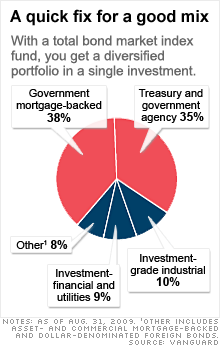
You can create a well-diversified bond portfolio that offers reasonable protection from rising rates with a handful of different bond funds of varying maturities. An easier way: Invest in a total bond market index fund that gives you the entire investment-grade taxable bond market in one shot.
Vanguard Total Bond Market Index fund (VBMFX), for instance, provided just the sort of steady performance you'd want from bonds during the recent economic tumult, rising 5.1% in 2008 and gaining 5% this year (to mid-September).
Cast a wider, safer net. Once you've built a strong foundation, think about branching out further by devoting, say, 10% to 20% of your bond portfolio to a combo of foreign bonds for international diversification, TIPs for inflation protection, and high-yield bonds for a shot at higher returns. (You'll find solid choices among the Money 70.)
But be careful, especially with high-yield bonds. While they can generate loftier gains than a typical fixed-income investment, they can also deliver stock-like losses in a downturn -- like last year, when such funds lost 26.4%.
If you're unsure, err on the side of safety rather than outsize returns. If that means you end up with a bond portfolio that seems dull, so be it. When it comes to bonds, thrills and chills are the last thing you need. 



