NEW YORK (CNNMoney) -- My money has been in six different mutual funds since 2004. I thought the investment profiles were different. Post-crash, when I (finally) looked into what each fund held, I found I had 37% in the financial industry. What's the best ways to make sure I'm diversified? -- Valerie Lam Rainey, Palo Alto
As you've learned, building a well-balanced portfolio is trickier than spreading your money among a handful of funds.
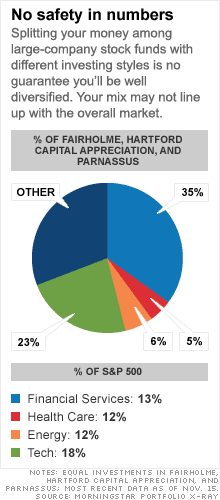
One reason is that you can't always tell how a mutual fund will deploy its assets -- a name may provide little clue.
And while checking a fund's investment category at Morningstar.com can give you a better idea, managers still have leeway to veer off in surprising directions.
Let's say that last year you invested in Parnassus (PARNX), Hartford Capital Appreciation (ITHIX), and Fairholme (FAIRX) funds. All three own big stocks, but Parnassus focuses on growth shares, Fairholme emphasizes undervalued companies, and Hartford blends those two approaches. So you might reasonably conclude that you owned a well-rounded group of large-company stocks.
In reality, however, your portfolio would have been seriously skewed, as you can see in the graphic. Fairholme had more than 70% of its assets in financial stocks last year, including Bank of America (BAC, Fortune 500). Parnassus stuffed more than half its assets into tech firms like Google (GOOG, Fortune 500). All three are domestic stock funds, but 19% of your money would have been in foreign shares.
You can do this same exercise by revving up Morningstar's Portfolio X-Ray, free at T. Rowe Price's website (registration required) and available to Morningstar subscribers ($21 a month; $185 a year).
By taking 15 to 30 minutes to plug in your holdings and click through views -- by asset class, investment style, or industry sector, for example -- you should have no trouble telling whether your portfolio is well diversified compared with market benchmarks.
If the proportions are off by only a few percentage points, relax; minor deviations aren't likely to dramatically affect performance.
But if your portfolio is out of whack by, say, five percentage points or more in any area, you may want to replace a fund whose holdings are especially lopsided with one that more closely tracks the broad market. Or to get more exposure where you need it -- tech, health care, whatever -- you can add a sector fund or an exchange-traded fund that tracks that particular area of the market. Just be careful that you don't create new imbalances.
An alternative to this fine-tuning is to stick to index funds and ETFs that track broad benchmarks (which have the added advantage of low fees). With just a total stock market index, total bond index, and total international index -- all available on our MONEY 70 list of recommended funds -- you can create a well-balanced global portfolio that's easy to maintain. 

Carlos Rodriguez is trying to rid himself of $15,000 in credit card debt, while paying his mortgage and saving for his son's college education.

Susan Carson and Laura DeLallo make $225,000 and have half a million in retirement savings, but their sprawling portfolios is proving hard to manage.
| Overnight Avg Rate | Latest | Change | Last Week |
|---|---|---|---|
| 30 yr fixed | 3.80% | 3.88% | |
| 15 yr fixed | 3.20% | 3.23% | |
| 5/1 ARM | 3.84% | 3.88% | |
| 30 yr refi | 3.82% | 3.93% | |
| 15 yr refi | 3.20% | 3.23% |
Today's featured rates: