CNNMoney.com
Companies Economy International Corrections Pre-market Trading After-hours Trading Winners/Losers/Actives Bonds Currencies Commodities World Markets Subscribe to Real Money Newsletter Subscribe to Money Magazine Money Magazine Real Estate Taxes Jobs Ask the Expert Money 101 Autos Mutual Funds The Help Desk Loan Center Best Places to Live Subscribe to Money Magazine Ask the Expert Ultimate Guide to Retirement Retirement Calculators Rules of Retirement Best Funds Best Places to Retire Fortune Brainstorm Tech Apple 2.0 Blog Big Tech Blog Sectors and Stocks Tech Talk Questions & Answers Innovation Nation Small Business Video 50 Best Places to Launch Resource Guide Next Little Thing Subscribe to Fortune Magazine Fortune 500 Brainstorm Tech Investing Management Executive Interviews Rankings

The 7 new rules of financial security

In a world turned upside down, you must re-examine some basic assumptions. A good place to start: understanding the true nature of risk.

1 of 7
BACKNEXT
Rule No. 1: Risk
Old thinking: If you can stomach the ups and downs that come with risk, you'll be rewarded.
New rule: Risk isn't about your stomach. It's about making or missing an important goal.


You know you have to consider risk. But what is risk? Many of us have learned to think of risk as synonymous with volatility. For years, what came down reliably bounced back even higher. You could easily conclude that risk tolerance was just a matter of taste. As long as you had the fortitude to see the occasional loss on your 401(k) statement and not panic, you would capture superior returns over time.

As you now know, the "over time" part of that last sentence is the real risk of relying too heavily on stocks. The longest period of negative returns for U.S. equities is 16 years, according to data collected by Wharton economist Jeremy Siegel. And we're at over a decade as of late February.

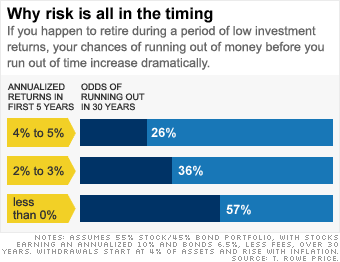
If you hit a slump in returns at the moment you need the cash, the eventual upside of volatility won't do you much good. Consider the analysis above from T. Rowe Price, which shows the impact of a weak market in the first five years after you retire. Because you have to sell falling assets to live on in the early years, your portfolio may be so small by the time the rebound comes that you still run out of money.

What to do: You shouldn't run from risky investments just because they lost money - that train has left the station. But the old buy-on-the-dips advice isn't quite right either. This bear market's lesson is that how much risk you can take is a matter of how much you can lose and still meet your basic goals. That may mean scaling back on stocks, even if you miss some of the next market rebound.
NEXT: Rule No. 2: Cash
Last updated April 13 2009: 6:02 PM ET
More Galleries
12 ways to cut your taxes The bright spot of the dreary 2009 economy: savings for everyone. More
Cashing in on the great condo bust Great bargains abound, but you have to shop carefully. More
Don't try to do this online Even good sites may have certain tools that aren't so hot. Some sites may make you poorer. And sometimes the problem is you. More

Special Offer
© 2010 Cable News Network. A Time Warner Company. All Rights Reserved. Terms under which this service is provided to you. Privacy Policy. Advertising Practices.
Copyright © 2010 BigCharts.com Inc. All rights reserved. Please see our Terms of Use.
MarketWatch, the MarketWatch logo, and BigCharts are registered trademarks of MarketWatch, Inc.
Intraday data provided by Interactive Data Real-Time Services and subject to the Terms of Use.
Intraday data is at least 20-minutes delayed. All times are ET.
Historical, current end-of-day data, and splits data provided by Interactive Data Pricing and Reference Data.
Fundamental data provided by Morningstar, Inc..
SEC Filings data provided by Edgar Online Inc..
Earnings data provided by FactSet CallStreet, LLC.