Who's the greenest bank of all?Sustainable building is all the rage - and big banks want in on the action, says Fortune's Marc Gunther. (Fortune Magazine) -- Waterless urinals! Plants on the roof! Recycled carpets! Since the first U.S. building was formally certified as good for the planet in 2000, "green" building has gone mainstream. So far about 900 projects have been certified by the U.S. Green Building Council, a Washington, D.C., trade association; another 13,000 are in the pipeline. "No fundamental change in the building industry has moved as quickly as sustainable building," says Timur Galen, head of corporate services and real estate at Goldman Sachs (Charts, Fortune 500).
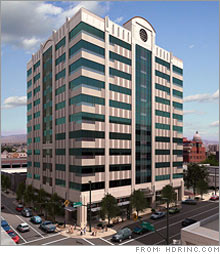
Goldman, as it happens, is a leader in the green building boom. The investment bank's 42-story Jersey City office tower, which opened in 2003, is the largest office building in the U.S. to receive the council's official nod, a Leadership in Energy and Environmental Design (LEED) certification. And Goldman's forthcoming $2.4 billion, 43-story headquarters in lower Manhattan is striving to attain the council's higher rating, LEED Gold. But other banks are aiming to outgreen Goldman. Bank of America's new 55-story building in Midtown Manhattan, scheduled to open in 2009, is expected to become the first skyscraper to obtain Platinum status, the council's highest LEED rating. And J.P. Morgan Chase (Charts, Fortune 500) says its new investment-banking headquarters planned for lower Manhattan will go for Platinum status too. But bragging rights in this arena belong to a modest 11-story building in Boise, the regional offices of Banner Bank. Completed in 2006, it is the only bank building actually up and running with Platinum status. LEED has become the de facto national rating system for the design, construction, and operation of so-called green buildings. There are four levels - Certified, Silver, Gold, and Platinum. Of the roughly 900 buildings that have earned LEED ratings in the U.S., only 42 notched a Platinum score. Governments, nonprofits, or universities built most of those, but a growing number are corporate headquarters. So, for example, the Bank of America (Charts, Fortune 500) tower will make its own electricity by burning clean natural gas, cool itself by producing tons of ice at night, and reuse "gray water" - that's what goes down the drain after you wash your hands - to flush toilets. Goldman's headquarters will do much of the same, but its score is expected to be slightly lower, says Galen, because of site constraints and the absence of onsite power generation. Why bother? Companies like to be able to say they are green, and the halo effect is even more appealing when it saves money. While green design carries higher building costs, advocates say they are recouped quickly in efficiency and worker productivity gains. BofA's architects, for example, figure the New York site will use half the water and half the energy of a conventional building. "The deeper you go into green design," says Gary Christensen, who owns the Banner Bank building in Boise, "the more you find cost savings to offset the higher expense." Good PR and good economics together - sometimes it is easy being green. |
Sponsors
|