|
White-water rafting -- in the city
This summer the first man-made rafting park in the U.S. opens outside Charlotte, N.C. Are more urban parks on the way?
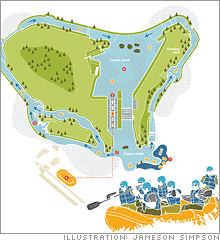
 CHARLOTTE, N.C. (FORTUNE Small Business) - Coming soon to a metropolis near you: Class IV rapids. Jeff Wise, a former software entrepreneur, is helping develop the first white-water park in the U.S., on a 307-acre plot outside Charlotte. The nonprofit park opens in June and will host world-class competitions, though Wise wants weekend warriors to show up too. "We're not selling kayaking," says Wise, 42. "We're selling a lifestyle." To that end, he plans to offer such amenities at the park as hiking trails and a cafe - along with treacherous eddies, seven-foot plunges, and 10,000-pound boulders the size of Humvees.
Wise is not alone. Entrepreneurs in cities around the world are pouring cascades of cash into man-made white-water parks in a bid to spur economic growth. The model for these rock-strewn, recirculating rivers is the Penrith Whitewater Stadium, a $6 million facility erected outside Sydney for the 2000 Summer Olympics. More than five years after the closing ceremonies, Penrith is churning out profits and has a three-month wait. Similar parks are already in place in Athens, Paris, and Nanjing, China. "You can put them pretty much anywhere," says Bob Campbell, 51, a former coach of the USA Canoe/Kayak team who now advises cities looking to open white-water parks. Since 2000, Campbell's seven-person firm, Whitewater Parks International, in Glenwood Springs, Colo., has fielded more than 200 inquiries. Wise, who founded Consentsys, a health-care software business he sold in 2001, has already seen signals that the Charlotte park will spawn other business opportunities for the area. Across the road from its entrance, developers are advertising unbuilt residential neighborhoods with names such as Whitewater Glen. To design the course, Wise brought in Scott Shipley, a fluid engineer with Recreation Engineering & Planning in Boulder. Before becoming an engineer, Shipley spent 13 years kayaking for the U.S. team, competing in the Summer Olympics three times. He included the waves, chutes, and obstacles of a natural river, along with seven enormous pumps to recycle water through the course, drawing the equivalent of an Olympic-sized pool every eight seconds. The project cost about $35 million, but Wise predicts that the nonprofit center will break even in its first year. While customers won't pay to bike, climb, or hike on the property, rafting groups will pay $15 to $25 a person for a 90-minute session on the course, which Wise says equates to a 5 �-mile ride down a natural river. Overlooking the water will be restaurants, a coffee bar, and retail stores as well as an airy conference center available for corporate retreats. Says Wise, an avid kayaker and mountain biker who runs 3:15 marathons: "Our goal is to keep you out long enough to eat, drink, and spend a little money." Official projections are for $11 million in annual revenue and $4 million in operating income, but that's based on about 300,000 visitors. Wise optimistically expects 500,000. In time, white-water parks could expose millions of city slickers to kayaking and canoeing. The sport's organizing body, the International Canoe Federation, has decreed that future World Cup events must be held on man-made rivers to take advantage of their access to spectators and made-for-TV layouts. Charlotte's park will be a U.S. Olympic training site and begins hosting competitions in 2007. "We've got a chance to really change the way people perceive these sports," says local banker Vic Howie, who has worked on the project from the start. It just takes tinkering with Mother Nature a bit. Additional reporting by Chuck Marvin Best travel reward cards. Click here.
Italy on the cheap. Read more. |
|