|
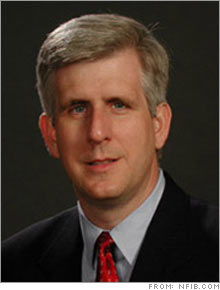
Is the NFIB losing its voice? The premier small-business lobbying group faces a tough new climate.  (FORTUNE Small Business) -- Todd Stottlemyer looked ready to start his tenure with a rousing victory. He had just been named CEO of the nation's top small-business advocacy group, the National Federation of Independent Business (NFIB). For years the group had been pushing federal legislation that would allow small companies to band together and buy insurance through association health plans, or AHPs, that would be exempt from state coverage requirements. The House had passed AHP legislation eight times over the past decade, but no bill had ever made it out of committee in the Senate. This spring, however, a bill cleared the Senate small-business committee and seemed headed for a vote on the floor.
Stottlemyer activated his fearsome lobbying machine, spending about $1 million on print and radio advertising in the states of key Senators across the South and Midwest and deluging Senate offices with petitions signed by entrepreneurs. As late as mid-April, Stottlemyer, 43, was confidently predicting, "This Senate floor vote is going to happen in May." But a Senate bill needs 60 supporters just to end debate and get on with a vote, and the NFIB could muster only 55. "We were very optimistic until the end," says NFIB lobbyist Amanda Austin. Now, she says, "we're right back to ground zero." Waning influence It was a painful and surprising setback for an outfit that is accustomed to winning. Under longtime CEO Jack Faris, who retired in February, the NFIB (nfib.com) - with its nearly 600,000 dues-paying members, outposts in 50 state capitals, and 51 well-funded political action committees - became one of the most powerful lobbying groups in the nation. The defeat of the Clintons' health-care plan, the 1994 rise of the Republican majority in the House, the rechristening of the estate tax as the "death tax" and the gutting of it - all were political stampedes whipped up with the help of the NFIB's money and membership. Thing is, those are old stories. Recent experience suggests that the NFIB's influence is on the wane. "While they are still significant, the assumption that they are calling the shots is not going to be there," says a senior congressional staffer and longtime NFIB antagonist, "especially if current dynamics continue." Among those dynamics: a deeply unpopular Republican President and an insecure Republican majority in Congress, now looking warily to the fall elections. Pro-Republican Those are troubling developments for the NFIB, which directed 98% of its congressional campaign contributions during the 2004 election cycle to Republicans. Faris, a former executive director of the Republican National Finance Committee, was so tight with President Bush that he merited a presidential nickname, Action Jackson. That must have delighted the NFIB's members - at least the 95% who identified themselves as Bush voters on the eve of the last election. (An exit survey after the election by the Small Business and Entrepreneurship Council found that 57% of small-business owners voted for Bush.) As long as the Republicans were in ascendance, the NFIB's partisanship was a plus. Not anymore. (For an idea of what can happen to an interest group when the party it brought to the dance is in decline, consider the fate of the AFL-CIO in the years since the Democrats lost control of Congress.) The NFIB can still mobilize its base on issues such as tax cuts. But its rigid partisanship limits its ability to sway Democratic lawmakers whose votes are needed to pass measures important to small-business owners. "They are not seen as small business," one congressional staffer said of the NFIB's members. "They're seen as Republicans who aren't going to vote for Democrats anyway." Of the Democratic Senators whose constituents were targeted for NFIB ads, only Mary Landrieu of Louisiana came aboard, joining Democratic co-sponsor Ben Nelson of Nebraska in support of the AHP bill. None of the other Democrats regarded as persuadable - including Colorado's Ken Salazar and Michigan's Debbie Stabenow - were moved by the NFIB's appeal. Non-partisan alternatives And what of issues that don't submit to partisan hammer blows? On immigration, for example, other business groups, including the U.S. Chamber of Commerce, have joined with labor unions and religious organizations to search for common ground. Not the NFIB. The reason, according to Stottlemyer, is that NFIB members are "split right down the middle" on amnesty for the 11 million illegals who are already here - a split that mirrors the one within the Republican Party. Hence the self-described "voice of small business" has had nothing to say about one of the most contentious issues of the day - one with far-reaching implications for its members. Then there's health-care reform, "one, two, and three" on the NFIB's list of legislative priorities for the past 20 years, according to Stottlemyer. Several fresh ideas are bouncing around, among them: Republican Governor Mitt Romney's Massachusetts plan requiring everyone to buy health insurance (and creating more-affordable options), tax-free health savings accounts for individuals, and Arizona Republican Representative John Shadegg's proposal to let consumers shop for health insurance in any state they choose. While the NFIB has expressed interest in all those notions, it has invested almost all its time, money, and political capital in the losing fight for AHPs - even though the Congressional Budget Office has calculated that approval of those plans will push premiums up for 75% of small businesses. This year the NFIB found itself opposed not only by AARP, the American Cancer Society, and 39 state attorneys general, but also by its ideological allies. The National Small Business Association favors health savings accounts, and the libertarian Cato Institute is wary of AHPs. "If the idea of association health plans is to make health insurance more affordable for small business," says Cato's director of health policy studies, Mike Cannon, "it will do so only in the short term. It will make it more expensive in the long term." So what explains the NFIB's obsession with the plans? "They could be looking at AHPs to bring in new members," says a Washington small-business expert, who notes that if AHP legislation passes, the NFIB could offer health plans as a membership benefit. (The NFIB points out that any profits or savings would be passed along to the plans' participants.) But there are other, less cynical explanations. "If you're strictly a one-party group," observes a Democratic Senate aide, "you're going to be a lot less willing to see what the other side is offering as a compromise and more apt to see it as eroding your position." That's one area where Stottlemyer might want to break the mold. (One encouraging sign: The NFIB's latest member ballot asks for opinions on health savings accounts.) Unlike his predecessor, Stottlemyer has a background in M&A and technology startups, experience he says will help him "take a fresh look at the organization." High on his list, he says, is doing a better job of mobilizing his members by sending them more targeted appeals based on their specific interests. As for the larger challenge - how to expand the NFIB's political reach -Stottlemyer says, "I certainly want to do that. I'm willing to see anybody, talk to anybody, who's for small business. It's not a Republican mandate, it's not a Democratic mandate." As we enter election season, and the NFIB distributes its PAC money, small-business owners and their supporters in both political parties will have a chance to see how serious he is. ____________________________ Related: Building wealth? Once you've made it, how do you keep it? 50 high-performing small cap stocks. |
|