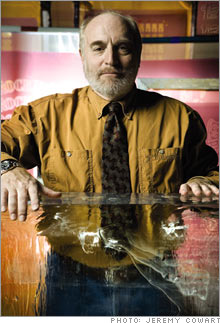
Keeping ice cold all winterA new technology saves steady streams of money for a Colorado manufacturer. (FSB Magazine) -- Brown Abrams had a problem. His company, FiberLok, based in Fort Collins, Colo., manufactures an advanced 3-D textile used as logo material on uniforms, baseball caps and the like. Clients couldn't get enough of the stuff, partly because Abrams, 59, couldn't run his delicate machines in hot weather. "Fort Collins is so hot and dry in the summer that our air conditioners couldn't keep up," Abrams recalls. "We had no choice but to shut down during the day from July to September." FiberLok's night-shift-only summer schedule was costing the company an extra $20,000 a year in overtime. The monthly utility bill at the 50,000-square-foot plant averaged a punishing $11,000 a month during the summer. And the defect rate rose in hot weather, costing FiberLok an extra $2,000 in product return costs.
Over 15 years, Abrams reckons he spent around $100,000 on consulting fees and new air-conditioning hardware, to no avail. He was ready to give up when he heard about Ice Energy, a startup based in Windsor, Colo., whose new Ice Bear cooling technology uses cheaper off-peak electricity to freeze a 520-gallon tank of water overnight. The system pumps refrigerant through coils in the ice and back to conventional air conditioners that consume less electricity in this process to generate the same amount of cool air. According to the manufacturer, the Ice Bear system also emits 30 percent to 50 percent less greenhouse gas than regular AC. While ice cooling systems are widely used in skyscrapers, Ice Bear is the only product of its kind designed for homes and small businesses. Caveat: It makes sense to install Ice Bear only if your local utility offers a variable-rate plan that gives customers an incentive to reduce power consumption during peak demand periods. Only 5 percent of U.S. power users are on such plans today, most of them commercial facilities in Florida, California and a few other states. But Bill Carnahan, executive director of the Southern California Public Power Authority, predicts that most utilities will implement variable pricing within the next five to ten years. One Ice Bear cools up to 150,000 square feet. Each unit retails for $10,500, plus installation fees, which can be substantial. Ice Energy charged FiberLok $17,200 to install two free trial systems, but the investment paid for itself in 287 days. Last summer FiberLok boosted production by 18 percent (about $103,000) over the previous year, while saving $32,000 in electricity, overtime and product-return costs. FiberLok lost one of its biggest customers last year but still grossed $10 million (similar to 2005), thanks in part to Ice Bear. Money isn't the only advantage. "Our clients are no longer disappointed ," says Abrams. "You can't put a price on customer satisfaction." ---------------------------- To write a note to the editor about this article, click here. |
Sponsors
|