
CNNMoney.com
Companies Economy International Corrections Pre-market Trading After-hours Trading Winners/Losers/Actives Bonds Currencies Commodities World Markets Money Magazine Real Estate Taxes Jobs Ask the Expert Money 101 Autos Mutual Funds The Help Desk Loan Center Best Places to Live Ask the Expert Ultimate Guide to Retirement Retirement Calculators Best Funds Best Places to Retire Fortune Brainstorm Tech Apple 2.0 Blog Big Tech Blog Sectors and Stocks Tech Talk Resource Guide Small Business Makeovers Questions & Answers Small Business Video 100 Best Places to Launch FSB 100 Fortune Small Business Fortune 500 Brainstorm Tech Investing Management C-Suite Rankings Main Create Portfolio Edit Portfolio Create Alerts Edit Alerts
10 big ideas for 2007
A look at the best innovations coming from small businesses next year.
Back to story
Electricity from wave power
Ocean Power Technologies
oceanpowertechnologies.com

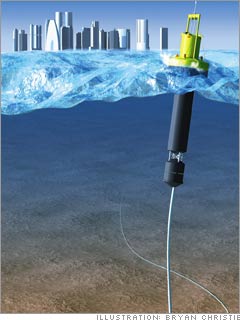
Starting in 2007, massive, predictable waves off the coast of Oregon will help light homes and businesses along the West Coast, thanks to an entrepreneur named George Taylor. A former surfer who grew up in Australia, Taylor, now 72, studied electrical engineering and spent the past 40 years as a small-business owner in the U.S. His most recent invention is a buoy that can convert a wave's up-and-down motion into electricity, which can be carried ashore by undersea cables and fed into the national power grid.

The buoys are an environmentalist's dream - barely visible from the beach, drawing on an abundant, renewable energy resource, with little or no impact upon marine life and emitting no gases that contribute to global warming. Buttressing Taylor's optimism, researchers at Oregon State University say that only 0.2 percent of the ocean's untapped wave energy could power the entire world. The buoys Taylor plans to install off Oregon in 2007 will generate electricity at rates competitive with that produced by coal - currently the cheapest, most abundant, most commonly used (and dirtiest) source of energy. Future generations of the buoys could conceivably produce power more cheaply than that.

By the year 2010 Taylor plans to have a 100-ton, 37-foot-wide buoy that could generate 500 kilowatts. An array of 40 buoys that size, linked together, could generate electricity at prices significantly less than that of a typical coal-burning power station, and far less than the price at plants that burn more expensive fuels such as natural gas. Clean electricity that cheap could be used to desalinate seawater, split water molecules to make hydrogen for fuel-cell cars or provide inexpensive power for other ambitious, energy-hungry projects. --Dan Drollette
Battle of the business plans Startups operating on the cutting edge dominated FSB's fourth annual student business plan contest. Meet the winners and runners-up. (more)
6 offbeat schools Throw knives! Be a spy! Learn some unusual skills in these classes. (more)
Where are they now? The winners of last year's FSB business-plan competition are growing rapidly. Here's an update. (more)
© 2009 Cable News Network. A Time Warner Company. All Rights Reserved. Terms under which this service is provided to you. Privacy Policy
Copyright © 2009 BigCharts.com Inc. All rights reserved. Please see our Terms of Use.
MarketWatch, the MarketWatch logo, and BigCharts are registered trademarks of MarketWatch, Inc.
Intraday data provided by Interactive Data Real-Time Services and subject to the Terms of Use.
Intraday data is at least 20-minutes delayed. All times are ET.
Historical, current end-of-day data, and splits data provided by Interactive Data Pricing and Reference Data.
Fundamental data provided by Morningstar, Inc..
SEC Filings data provided by Edgar Online Inc..
Earnings data provided by FactSet CallStreet, LLC.