
Founders: Rodrigo Alvarez, 31; Howard Katzenberg, 28; Rahul Kothari, 30
Date launched: April 2006
Startup capital: $26,000 in prizes from business plan contests
School: The Wharton School, University of PA
Product or service: A muscle-like device to replace traditional motors in prosthetic and orthopedic limbs, providing a quieter, less bulky and less expensive alternative, according to its founders.
Chief scientist Rodrigo Alvarez (left), created a new kind of flexible artificial muscle made of plastic. With two MBA students from the Wharton School, Rahul Kothari (right) and Howard Katzenberg, Alvarez launched MuscleMorph (www.musclemorphco.com), which aims to use that artificial muscle to transform the prosthetics industry by providing a new way to move artificial limbs. Much like a human muscle, Alvarez's device is composed of thousands of strands of microfibers, which respond to electrical charges from a battery by contracting smoothly and silently. In the lab, the founders claim, MuscleMorph's prototype has proved as strong and as responsive as human muscle. The company holds two provisional patents on the technology.
MuscleMorph's device comes at a critical time for the prosthetics industry. There are about 1.8 million amputees in the U.S., and their numbers are expected to increase because of a rising incidence of heart disease and diabetes.
Several motorized prosthetics have come on the market in the past year, but they are bulky, noisy and power-hungry machines that cost between $50,000 and $100,000. Limbs using MuscleMorph's technology will have more lifelike motion, could cost significantly less - and will be completely silent, claims Kothari.
To speed its path to market, MuscleMorph is seeking $1.5 million from angel investors. It already faces some brawny competition. Artificial Muscle in Menlo Park, Calif., was spun off in 2004 from SRI International, one of the world's largest contract research institutes, and has attracted about $10 million in venture capital. Last January, Artificial Muscle introduced its first "muscle," using technology similar to MuscleMorph's. However, this rival says it does not intend to focus initially on the prosthetics market, but on the consumer electronics, automotive, and industrial markets, leaving MuscleMorph with a good shot at putting millions of amputees back on their feet. --Patricia B. Gray
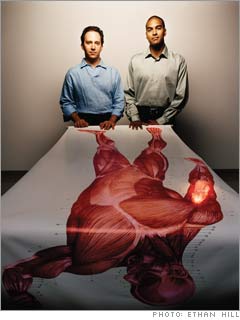
First Place: MuscleMorph
|
 The winners of last year's FSB business-plan competition are growing rapidly. Here's an update. (more)
 How small companies are using new technologies to compete like champions. (more)
• 5 ways to compete with the big boys  Running a multinational from a home office Running a multinational from a home office
|
