


Hillary's modest proposal (to wreck the housing market)
The current mortgage mess requires a more intelligent approach than the buzzsaw plan floated by Hillary Clinton.
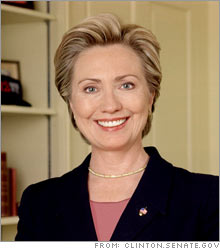 |
| Hillary Clinton's proposal to freeze interest rates for five years could be disastrous. |
(Fortune) -- Hillary Clinton is no dummy. Even her detractors know that. And yet in last night's Democratic presidential debate in Nevada, Clinton floated what is perhaps the dumbest solution to the current mortgage mess I've heard from a top presidential contender.
"I have a plan - a moratorium on foreclosures for 90 days [and] freezing interest rates for five years, which I think we should do immediately," Clinton announced at what was the last Democratic debate before the Nevada Caucus on Jan. 19. A 90-day moratorium on foreclosures would throw a lifeline to some deserving homeowners, though I suspect it would only delay the inevitable for most. That's not my beef.
Where Clinton goes awry is her proposal to freeze mortgage rates for five years, which is essentially a much broader version of a deal President Bush recently hammered out with lenders to assist some subprime borrowers. If Clinton's only goal were to bail out homeowners facing steep rate resets on adjustable mortgages, her plan would work just fine.
For everyone else though, such a freeze would be disastrous. Interest rates on new mortgages would skyrocket - perhaps past 8 percent, as the mutual funds, pension funds and other investors who typically provide capital to the mortgage market shift their money into other investments where the government isn't impairing returns. With higher mortgage rates eroding buying power, the downward pressure on home prices would only increase. Lower home prices would lead to even more defaults, as more folks who'd lost the equity in their homes choose to walk away from their mortgages.
"It certainly would not speed the recovery of the housing market," says Doug Duncan, chief economist of the Mortgage Bankers Association. "The problem now is that investors are already worried about what the risks are, and (a rate freeze) would only widen risk premiums more."
Then there's the long-term impact such a bailout would have on behavior. While Clinton's plan would no doubt save some legitimate victims who were duped into taking out bad loans, she'd also be saving the flippers and speculators who knew the risks of low teaser rate mortgages but figured (wrongly) that they could always sell their house for a profit if the reset mortgage rate proved unaffordable. Bailing out these folks now would only encourage them to take even bigger risks down the line.
To be fair, John Edwards, has endorsed an even broader rate freeze - one lasting seven years - and he also wants to give homeowners the right to halt foreclosures if lenders haven't made a "good faith" effort (whatever that means) to rework the loan. Edwards, however, seems a longshot to win the White House.
Barack Obama, meanwhile, wants to require better disclosure by lenders (of low teaser rates, for example) and, like Clinton and Edwards, proposes a government fund to help borrowers transition from unaffordable adjustable mortgages to lower-rate fixed ones.
When it comes to a rate freeze, Duncan and the Mortgage Bankers Association aren't exactly disinterested parties, of course. A freeze would directly impact the bottom line of MBA members. However, when I discussed Clinton's plan with a more sympathetic economist - one who'd worked for Bill Clinton - his reaction was much like mine and Duncan's. "This is an ugly correction, but it's a necessary one," says Jared Bernstein, senior economist with the liberal-leaning Economic Policy Institute. "This kind of an idea is a little bit of untying your shoes with a buzz-saw." 


-
 The retail giant tops the Fortune 500 for the second year in a row. Who else made the list? More
 -
 This group of companies is all about social networking to connect with their customers. More
 -
 The fight over the cholesterol medication is keeping a generic version from hitting the market. More
 -
 Bin Laden may be dead, but the terrorist group he led doesn't need his money. More
 -
 U.S. real estate might be a mess, but in other parts of the world, home prices are jumping. More
 -
 Libya's output is a fraction of global production, but it's crucial to the nation's economy. More
 -
 Once rates start to rise, things could get ugly fast for our neighbors to the north. More








