
 |
FORTUNE | |
| The Deal |  Full coverage Full coverage |
|


Don't expect another bull market
Stock returns may never be the same - at least for this generation of investors.
(Fortune) -- Although you won't find it listed on your calendar, we're approaching the anniversary of an epochal event. No, it has nothing to do with the NCAA basketball tournament. It's a different kind of March Madness: The end of the bull market that lasted for a generation and changed the way that Americans think about stocks.
When the greatest bull market in U.S. history started in the summer of 1982, only a relative handful of people owned stocks, which were cheap because they were considered highly risky. But by the time the Standard & Poor's 500 peaked in March 2000 amid a fully inflated stock bubble, the masses were in the market. Stocks were magical, a supposedly can't-miss way to pay for your kids' college, save for retirement, enrich employees by giving them options, and regrow hair. (Just kidding about the hair. Alas.)
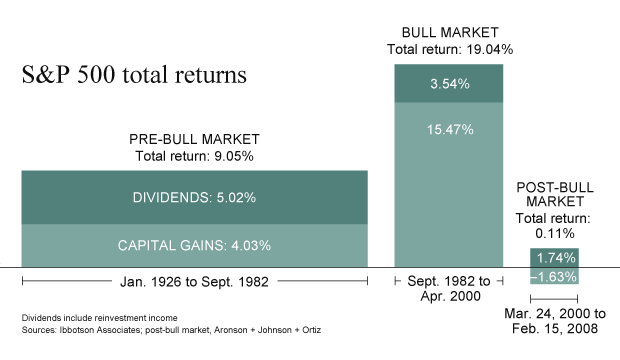
Stocks might go down in any given year, the mantra went, but in the long term they'd produce double-digit returns. However, one of the lessons of the past eight years is that the long run can be ... really long. As I write this in late February, the U.S. market - which I'm defining as the Standard & Poor's 500 - is well below the high that it set on March 24, 2000. Even after you include dividends, which have run a bit below 2% a year, you've barely broken even, according to calculations for Fortune by Aronson & Johnson & Ortiz, a Philadelphia money manager.
Hello? Eight years of dead money in the broad stock market? How can that be, given that Ibbotson Associates says the S&P has returned an average of 10.3% a year, compounded, since 1926? Think of it as a six-foot man drowning in a pond with an average water level of six inches - if you step in at the wrong place, the water can be eight feet deep.
To be sure (the favorite phrase of us journalistic hedgers), this has been a flukishly bad period. Ted Aronson says that it's in the bottom 2% of the almost 900 different 96-month periods in the Ibbotson statistical universe. Nevertheless, it's the return we have.
Barring a miracle - or the creation of a New Math of the market variety - there's no way we'll ever see a bull market along the lines of what so many of us grew up with. During that enchanted period, the boring old S&P returned more than 19% a year. When you include compounding, your money more than doubled every four years. Pretty slick.
That was more than twice what stocks earned in the previous 56 years, when they returned about 9%. More than half of that was from dividends, which were almost triple their current level.
Roger Ibbotson points out that my eight-years-of-barely-breaking-even number comes from starting at an artificially high point. He's right, of course. Had I had begun with October 2002 - when the S&P bottomed some 49% below its peak - I'd have about doubled my money in less than six years. He predicts total returns of 8% to 9% over the long term, somewhat less than the 9.3% he forecast in Fortune in late 2005. But of course no one knows what stocks will do - other than fluctuate.
I'm reasonably sure, though, that stocks are likely to outperform high-quality bonds in the long term - not much of an accomplishment in a world where 30-year Treasuries yield about 4.5%. However, I don't expect to be able to earn almost 20% a year for 18 years owning an S&P index fund. The long bull market was great. But it's not coming back- at least for this generation of investors. Get used to it. 


-
 The retail giant tops the Fortune 500 for the second year in a row. Who else made the list? More
 -
 This group of companies is all about social networking to connect with their customers. More
 -
 The fight over the cholesterol medication is keeping a generic version from hitting the market. More
 -
 Bin Laden may be dead, but the terrorist group he led doesn't need his money. More
 -
 U.S. real estate might be a mess, but in other parts of the world, home prices are jumping. More
 -
 Libya's output is a fraction of global production, but it's crucial to the nation's economy. More
 -
 Once rates start to rise, things could get ugly fast for our neighbors to the north. More








