


Riding the money train
Railroads are benefiting from the global commodities boom - and the fact that trains are more fuel-efficient than trucks.

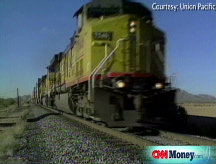


(Fortune Magazine) -- High energy prices have started to put a dent in corporate profits. But surprisingly, one industry that relies heavily on oil has not been hurt: the railroads. Most of the nation's top railroad companies have chugged along with strong sales and earnings increases in 2008, their results stoked by rising demand for transporting food and coal.
Investors have shown their appreciation: Even as much of the market has been thrown off track by the stalling economy this year, the four rail companies in the Dow Jones transportation average - Burlington Northern Santa Fe, CSX (CSX, Fortune 500), Norfolk Southern (NSC, Fortune 500), and Union Pacific (UNP, Fortune 500) - have seen their stock prices pick up steam with an average 29% increase through Aug. 18.
Despite that run-up, fund managers still see bargains in the group. "It appears to me that the rails all have a ways to go," says Craig Hodges, co-manager of the Hodges fund, which owns shares of Burlington Northern Santa Fe, Kansas City Southern, and Union Pacific. "Revenue growth is phenomenal, and the stocks are all reasonably valued."
Surging global demand for commodities has helped lead to increased shipments of corn, soybeans, and coal in recent months. And despite that slowing economy, which has hurt sales of some of the consumer goods that railroads transport, growth should be fairly robust for the remainder of this year and 2009. According to estimates from Thomson Reuters, the four big U.S. railroads are expected to report an average sales increase of nearly 16% in the second half of 2008, and 8% next year.
There's no mystery to the railroads' success: It costs less to transport goods by rail than by truck, especially when fuel costs are high. According to the American Association of Railroads, trains can move a ton of freight 431 miles on one gallon of diesel - about three times as far as a truck can. To be sure, the railroads have had to grapple with high oil prices too. But they have been able to pass along much of the higher fuel costs to customers. Burlington Northern engineered a $400 million fuel surcharge that offset most of the $474 million more in fuel expenses that it paid in the second quarter, compared with a year ago. Simply put, railroads are one of the few industries that enjoy pricing power, because even with the surcharges, they are more cost-effective than the competition. Says Hodges: "In some respects, the more expensive oil is, the more advantages they have."
Which rail stocks look best? Rafael Resendes, manager of the Toreador Large Cap fund, says his favorite today is Burlington Northern Santa Fe (BNI, Fortune 500), because it is attractively valued and boasts what he considers the best management team in the business. Shares trade at 18 times the past 12 months' earnings, only slightly higher than their five-year average trailing P/E of 16. What's more, Burlington has a PEG ratio of 1.3 (that's the price/earnings ratio divided by projected long-term earnings growth). The average PEG ratio for stocks in the S&P 500, by comparison, is 1.6. Burlington is also a favorite of Warren Buffett's; his Berkshire Hathaway is Burlington's largest investor, holding about 18.5% of the railroad's shares. It bought nearly three million of those shares in the first quarter of this year.
Both Hodges and Kent Croft, a portfolio manager at Croft Funds, recommend the stock of Kansas City Southern (KSU), a regional railroad that primarily runs a north-south line from Canada to Mexico, the so-called NAFTA railway. Kansas City Southern is expected to grow faster than most of its larger rivals: Profits are forecast to increase at about an 18% clip annually, on average, for the next few years, according to Thomson Reuters, compared with a growth rate of 16% for the overall railroad group. As a result, the shares trade at a premium - 22.5 times 2008 earnings estimates - vs. an average forward P/E of 17 for the Big Four railroads.
Nonetheless, Kansas City Southern's stock is appealing, in part because the company's lucrative growth prospects make it a possible takeover target. Hodges says it would make sense for any of the Big Four U.S. railroads to buy it, while Croft argues that Kansas City Southern would be a good fit for Canadian National. Either way, investors are betting that its days as an independent are numbered. "Kansas City Southern is not cheap, because everyone thinks somebody else should own it," says Croft. But with the company's potential for acquisition and its steady growth prospects, Kansas City Southern shares seem destined to stay on track. 


-
 The retail giant tops the Fortune 500 for the second year in a row. Who else made the list? More
 -
 This group of companies is all about social networking to connect with their customers. More
 -
 The fight over the cholesterol medication is keeping a generic version from hitting the market. More
 -
 Bin Laden may be dead, but the terrorist group he led doesn't need his money. More
 -
 U.S. real estate might be a mess, but in other parts of the world, home prices are jumping. More
 -
 Libya's output is a fraction of global production, but it's crucial to the nation's economy. More
 -
 Once rates start to rise, things could get ugly fast for our neighbors to the north. More









