


Playing the blame game
Americans want simple answers to our economic woes. Here are four.
 |
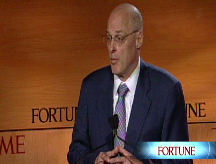
| When the history of this crisis is written, former Fed chief Alan Greenspan could bear the brunt of the blame. |

(Fortune Magazine) -- What happened in 2008?
Chances are you can't succinctly express your views on that complex question. But the American public will settle on one of four catch phrases over the next several months. Whatever bit of conventional wisdom wins out will have an impact on the economy. The contenders are as follows.
Free markets ran amok. The broad deregulatory trend of the past 30 years finally went too far.
Financial geniuses cooked up new ways to buy, slice, dice, reconstitute, and sell mortgages as novel securities that no one really understood but that investors were willing to buy because rating agencies - clueless, conflicted, and unregulated - said they were solid. Mortgage brokers were permitted to confuse and deceive prospects.
Supposedly stabilizing the whole system was a multitrillion-dollar market in credit default swaps that was totally unregulated. When government fails to police the financial sector strictly, that is what happens.
If this version wins out, watch for heavy new regulation of risk markets and financial institutions - leading to reduced innovation, profitability, and market values in the sector.
Greenspan did it. In the late 1990s, when former Federal Reserve chairman Alan Greenspan knew that stock prices were irrational, he failed to put the brakes on, and then, trying to rescue the economy after the resulting market bust from 2000 to 2002, he cut interest rates too far too fast. Credit became insanely easy throughout the economy, and everybody but him could see it.
He even reassured the nation that there wasn't a housing bubble, and such words from the maestro emboldened hapless homebuyers to continue down their doomed path of paying and borrowing ever more money.
When one person gains so much influence over the financial system and screws up, the result is disaster. Expect little structural change but intense new congressional and media scrutiny of the Fed if this explanation triumphs.
Bill Clinton spawned the subprime epidemic. To gain favor with the lower-income voters who are an important part of their base, the Democrats heavily revised the Community Reinvestment Act in 1995 and took other measures that virtually forced lenders to give mortgages to subprime borrowers.
Remember the outcry over redlining, the practice of refusing to lend for homebuying in certain neighborhoods? Congress sure fixed that, and now those neighborhoods are the hot zones of the foreclosure crisis. Banks that refused to lend to those borrowers weren't evil, they were prudent - until Clinton and Congress made that illegal.
Even if Democrats have come to believe this now, they will be hard pressed to narrow the scope of homeownership. So expect little change.
Americans lost their self-discipline. Lenders, borrowers, and investors - everybody forgot that financial life requires hard work and is filled with risk. Mortgage lenders had good reasons for demanding that borrowers submit mountains of paperwork and make a 20% down payment, and borrowers quite rightly felt their hearts in their throats when they signed the note.
All that disappeared from 2002 to 2008. Millions of us in every part of the system chose to believe that we could get rich quickly, easily, and safely, that work and risk assessment no longer mattered.
When a whole society decides to abandon basic virtues, large-scale trouble is certain. Wide embrace of this view would strengthen financial companies as Americans became bigger savers and would create new businesses as economizing became more chic.
It's fine to argue that the real answer is a nuanced combination of these and other factors, but that won't do. By this time next year, public opinion will have settled on a one-sentence explanation. (If you doubt our propensity for reducing complex economic maladies to blurbs, think of how the Great Depression is now remembered as something Herbert Hoover got us into and F.D.R. got us out of.)
So what happened in 2008? Of course I like the nuanced combination of factors, but if forced to order off the menu above, I'd say that answer No. 4 is the most nearly correct. My prediction is that answer No. 1 will win. I hope I'm wrong. 


-
 The retail giant tops the Fortune 500 for the second year in a row. Who else made the list? More
 -
 This group of companies is all about social networking to connect with their customers. More
 -
 The fight over the cholesterol medication is keeping a generic version from hitting the market. More
 -
 Bin Laden may be dead, but the terrorist group he led doesn't need his money. More
 -
 U.S. real estate might be a mess, but in other parts of the world, home prices are jumping. More
 -
 Libya's output is a fraction of global production, but it's crucial to the nation's economy. More
 -
 Once rates start to rise, things could get ugly fast for our neighbors to the north. More









