
A fund by any other name
Chuck Akre's FBR Focus fund has been called many things over the years, but his strategy has stayed the same.



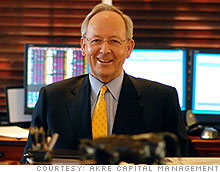 |
| Chuck Akre, Managing Member and CEO, Akre Capital Management |
NEW YORK (Fortune) -- Since Chuck Akre started his fund in 1997, it's had four different names and has been categorized as a value, growth, core, small-cap, and mid-cap fund.
"I've managed the portfolio the whole time and I've never changed the investment approach," he says. "We've been all of them. I don't box myself in."
And the approach has worked. FBR Focus - its current incarnation - has a five-star rating from Morningstar, and with 10-year annualized returns of about 10%, it ranks first in its mid-cap growth category.
The fund has about $800 million in assets, and Akre, who says he is a true believer in investing where his mouth is, has a seven-figure stake of his own money in the fund.
Akre, who likes to say that he's been in the investment business "since dirt," uses what he calls a "three-legged stool" approach. The first leg is examining business models of companies that have a history of generating above-average rates of return. The fund's historical threshold is about 20%, but in the current market environment he'll consider returns in the upper teens.
"We spend a lot of time trying to figure out what's causing this," he says. "What is it that allows them to have what the world calls 'the economic moat'?"
The second leg of the stool is studying management teams to see if they have a record of acting in the best interest of shareholders. Akre follows that up with the final leg, which looks at reinvestment opportunity. He wants a company to be able to reinvest its capital in a way that it allows it to earn unusually high rates of return.
Once he's found this "compounding machine," he's got a winner - but only if he doesn't have to pay too much for it, he says.
Akre runs a concentrated portfolio with about 23 securities. Its top 10 holdings make up about 75% of net assets. He tends to invest primarily in small- and mid-cap stocks because they usually can achieve higher growth rates, he says. Akre is strictly a bottom-up investor and doesn't focus on a particular sector (although he says he tends to stay away from healthcare and tech).
Akre will sell if a company's performance isn't holding up, but once he finds an investment he likes, he tends to hold it for the long haul.
American Tower (AMT) had a market cap of $200 million when he bought it about 7 years ago. Today it's more than $11 billion. The cell phone tower company has the strongest balance sheet in the sector and is the most conservatively financed, Akre says.
Penn National Gaming (PENN), a top five holding, is one of the biggest regional operators of slot machines casinos in the country. Akre started investing in the company in 1995, predating the fund.
"They see their profits every day in cash," he says. "You don't have a receivables issue." Even in an economy where casino visits are down, it's still a high cash business, he says. Akre thinks Penn will be able to take advantage of an industry in chaos. It has a much stronger balance sheet than its competitors and a history of being opportunistic with acquisitions.
Markel (MKL), another top holding, sells specialty insurance ranging from policies for horse owners to children's summer camps. It has about 95 different products, and no single one is hugely important to the business, Akre says.
The company has been able to compound shareholders' capital at rates that are close to 20% over the last 23 years, according to Akre. During Hurricane Katrina, Markel had losses twice what models predicted, but it didn't have to raise any capital. "That's a reassuring business model," he says.
O'Reilly Automotive (ORLY), which Akre added to the fund a year and a half ago, makes up about 7.5% of the portfolio. The fund's stake is partly so large because last year O'Reilly bought CSK Auto, which Akre already had in his portfolio. The auto parts supplier splits distribution between independent garages and retail stores for do-it-yourself clients.
"It's a fabulous business, particularly in this environment," he says, "because people are keeping cars longer, and the longer you keep a car the more parts you need for it."
While Akre tends to hold large positions, T. Rowe Price (TROW), one of his most recent investments, makes up about just 0.6% of the portfolio. "We bought it when the market was just giving things away," he says. "We'll own more of it if we get a chance to buy it a little more cheaply than it is right now."
He likes the investment management company because he understands the business, and it's one of only a handful of companies like it that's more than 70 years old. He also values the culture, where employees own about 5% of the company's stock, and reports have indicated that when retirees are included, that figure goes north of 20%, he says.
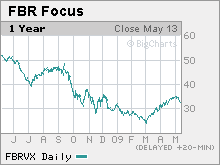
The FBR Focus fund is down 26.05% from a year ago, but it beat out the mid-cap growth category, which dropped 38.81%, according to Morningstar. Still, that's no solace to Akre.
"In 2008 we got it wrong," he says. "That's just the reality."
Akre has stared arranging office lunches that have included a former high-ranking government official involved in economic policy, an expert in sustainable agriculture, and the president of a major charitable organization. The purpose, he says, is "to help us think about the world in general in ways that are better than we have in the past."
"We will still be bottom-up stock pickers," Akre says, "but we just want to be better thinkers." 


-
 The retail giant tops the Fortune 500 for the second year in a row. Who else made the list? More
 -
 This group of companies is all about social networking to connect with their customers. More
 -
 The fight over the cholesterol medication is keeping a generic version from hitting the market. More
 -
 Bin Laden may be dead, but the terrorist group he led doesn't need his money. More
 -
 U.S. real estate might be a mess, but in other parts of the world, home prices are jumping. More
 -
 Libya's output is a fraction of global production, but it's crucial to the nation's economy. More
 -
 Once rates start to rise, things could get ugly fast for our neighbors to the north. More









