
Tech sector has questions, few answers
The execs at the AllThingsD tech conference are at a strategic crossroads.



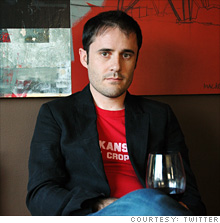 |
| Twitter co-founder Evan Williams. |
CARLSBAD, CALIF. (Fortune) -- -- Here's how scary the times are in the technology industry: Nobody, not even the visionary, congenitally optimistic smartypants who invent the technological future, has a clue about where we're going next.
The Twitter guys don't know how they're going to make money. AT&T (T, Fortune 500) doesn't know how the ever-increasing universe of smart phone operating systems will consolidate. Yahoo (YHOO, Fortune 500) (still) doesn't know who it is. Even John Malone, the veteran innovator of the communications business, isn't sure how producers of content will get customers to pay them for their wares.
A step back. The scene is the Wall Street Journal's AllThingsD conference near San Diego. The subject is the tech business, hammered by the economy and otherwise in the middle of one of its traditional periods of transition. That there are more questions than answers arguably is a good thing. From confusion typically comes the great, unexpected successes of this business. But it's unsettling all the same.
Take, for example, Twitter the "it" site of the consumer-technology world, which also happens to be the pinata of techdom. It's popular because people love the immediacy of sharing 140 characters worth of information with friends and strangers alike. Yet Twitter is under attack because there's no visible strategy for the young company to make money. (See: Twitter: Buzz first, profits later)
Founders Evan Williams and Biz Stone had a wonderful answer to their badgering interviewers Walt Mossberg and Kara Swisher (the conference's impresarios) as to what Twitter will do next and when it will make money: "We don't know." What was cool about Williams and Stone is that they didn't seem to care what Mossberg, Swisher or the high-falutin' tech audience thinks about their progress.
Famed investor Roger McNamee begged Twitter to build their 45-person company more quickly to take advantage of its rapid growth. Williams politely suggested McNamee check out the jobs page at Twitter's web site. Where will Twitter go next? Williams and Stone boldly suggested they'll follow customer preferences, an explanation you'd think techies would appreciate. By and large the techies weren't satisfied.
AT&T CEO Randall Stephenson says his company's churn rate - the speed with which customers ditch the service - has gone down in relation to the competition. He says this is because of the massive investments AT&T has made in its network. Could it also be the success of the iPhone, which AT&T distributes exclusively in the U.S.? Sure it could be.
He also said the heavy and (unquantified) subsidy AT&T pays to sell iPhones relatively cheaply is worth it to AT&T. It's an assertion he can't yet prove. Most interestingly, Stephenson said he can't predict how many smartphone operating systems will survive among the many in the market today:Apple's (AAPL, Fortune 500), Palm's (PALM) WebOS, Blackberry, Google (GOOG, Fortune 500)'s Android, Microsoft's (MSFT, Fortune 500) Windows Mobile, Nokia's Symbian, and more. It's an unsatisfying analysis. Most smart observers of the mobile world think the industry will consolidate around about three systems. That shakeout will be ugly, and it serves AT&T - which can sell phones made by every manufacturer - to let its suppliers slug it out rather than to have an opinion.
Carol Bartz became the third Yahoo CEO, after Terry Semel and Jerry Yang, to try to explain Yahoo's mission at this conference. Bartz wowed the crowd by projecting an image of confidence, competence and decisiveness. But she had little to say that truly was all that different from what Semel and Yang said in earlier years about what Yahoo is, how it's truly different from Google or what she'll do to change the company. "My job is to ask questions," Bartz said.
That's undoubtedly true for a while. Eventually, though, Bartz will be paid the big bucks to have the answers, not just the questions. (She did forcefully suggest she'll sell Yahoo's search business to Microsoft for the right price. That's an example of the decisiveness people love about Bartz.)
Some people at least have partial answers, an example being Liberty Media's John Malone. He helped create the cable industry, and he explained that cable operators got people to pay for television by offering them something they were willing to pay for, connectivity, with premium content (like HBO) they were then willing to pay even a little bit more.
"Advertising has been insufficient," Malone said, to pay for the production of high-quality content online. There has to be something more, and though he too had no answers, he offered at least a framework: Sell users something they'll buy, then upsell them more.
Unsatisfying answers in difficult times. But a start. 


-
 The retail giant tops the Fortune 500 for the second year in a row. Who else made the list? More
 -
 This group of companies is all about social networking to connect with their customers. More
 -
 The fight over the cholesterol medication is keeping a generic version from hitting the market. More
 -
 Bin Laden may be dead, but the terrorist group he led doesn't need his money. More
 -
 U.S. real estate might be a mess, but in other parts of the world, home prices are jumping. More
 -
 Libya's output is a fraction of global production, but it's crucial to the nation's economy. More
 -
 Once rates start to rise, things could get ugly fast for our neighbors to the north. More









