
Muni bonds under the microscope
An inflow of investor cash is making the safe-looking securities look a lot better than they really are.



NEW YORK (Fortune) -- One of the few safe market havens this year has been an old standby -- good old municipal bonds. But their solid performance might just be the result of overzealous retail investors.
The municipal bond market has been on a tear. The Barclays Capital Municipal Bond Index, which tracks investment grade muni-bond prices, is up over 7% on the year. And the average exchange-traded muni fund after fees, according to Bloomberg data, has gained 4.7%. That's about twice the return on corporate bonds - and way better than the roughly 5% drop for Treasuries.
The rise has largely been fueled by two factors: One is a drop in new debt. Municipalities have issued $20 billion less in bonds so far this year than at the same time last year. The collapse of municipal bond insurers, so-called monoline insurers like MBIA, plus a spike in borrowing rates meant many states and localities felt they were better off staying on the sidelines.
The other factor is skyrocketing retail demand. According to AMG Data Services, which tracks municipal bond money flows, muni funds have been gaining investors for 20-straight weeks, with $12.4 billion in new investments. Of the seven biggest monthly gains in muni fund assets ever, four have been this year, according to Bank of America's Merrill Lynch Research.
But while it was reasonable to be attracted to municipal bonds at their dirt-cheap prices at the beginning of the year, the fact that investor cash continues to flow into the market is probably making them seem like better investments than they are.
After all, the fundamentals of the muni market still aren't great: With high unemployment, states are collecting much less in taxes. And while jobless claims are growing at a slower rate, new jobs still aren't being created. Rating agency Moody's recently put all general-obligation bonds (that is, bonds raised not for a specific project, but just for cash for the government) on a credit watch.
"The muni sector can be expected to continue to find tax receipts declining even if the economy stabilizes," wrote Bank of America's Merrill Lynch analyst Philip J. Fischer in a recent note, "since taxes lag overall growth."
Even so, states still have a lot of projects to fund, especially with the need to create jobs by getting infrastructure projects off the ground. Supply is bound to increase, argues Hugh McGuirk, who manages municipal investments for T. Rowe Price's funds. "We've had light supply for the last few months," he says, "but we keep hearing issuers have capital needs. If they all come into the market in a hurry, it will put a real strain on prices."
Adding to that risk, he says, is the fact that the banks that underwrite bonds don't have the capacity to buy nearly as many bonds themselves and soak up excess capacity. "Underwriters aren't willing to stock bonds because of their own balance sheet problems," says McGuirk. "So any new issues will be priced aggressively to sell."
States are finding other ways to get to market. A new kind of security created last year, the Build America Bonds (BABs), are taxable municipal bonds designed to help states get access to corporate bond markets (the taxes paid on the bonds are rebated to the state by the federal government). Though adoption had been slow at first, in the past two months nearly $15 billion worth have been issued.
Such bonds could absorb some of the states' funding needs, tamping down supply of traditional bonds and keep their prices up. But BABs aren't expected to have a huge impact. "We don't believe that the emergence of this new product threatens the [issuance of tax-free municipal bonds]," wrote Eric Beinstein, a municipal bond strategist at J.P. Morgan in a recent note, "because the amount of expected issuance is relatively small." He expects only $70 billion to be issued, relative to the roughly $250 billion overall market.
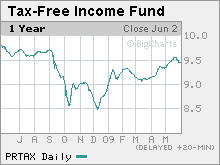
To deal with the potential volatility, McGuirk says he is focusing T. Rowe Price's funds (like the Tax-Free Income Fund, which has returned 9% this year) on bonds funded by utility bills - which are bills that even unemployed people usually pay - rather than by sales tax revenues, to reduce his portfolios' risk of defaults.
And states that have raised sales taxes also need to have raised their income taxes, like Maryland has, so they don't become too reliant on consumers. "If a bond is highly dependent on sales tax revenues, that's one I'd think twice about," says McGuirk. "People will stop shopping before they stop using water or electricity." 


-
 The retail giant tops the Fortune 500 for the second year in a row. Who else made the list? More
 -
 This group of companies is all about social networking to connect with their customers. More
 -
 The fight over the cholesterol medication is keeping a generic version from hitting the market. More
 -
 Bin Laden may be dead, but the terrorist group he led doesn't need his money. More
 -
 U.S. real estate might be a mess, but in other parts of the world, home prices are jumping. More
 -
 Libya's output is a fraction of global production, but it's crucial to the nation's economy. More
 -
 Once rates start to rise, things could get ugly fast for our neighbors to the north. More









