
Wal-Mart celebrates its growing market share
At a festive annual meeting with entertainment by Miley Cyrus and Smokey Robinson, new CEO Mike Duke vows to hang on the company's recent gains.



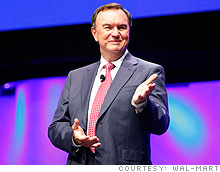 |
| Wal-Mart CEO Mike Duke |
FAYETTEVILLE, ARK. (Fortune) -- Somewhere Sam Walton is smiling.
You wouldn't know that the country is struggling through one of the worst recessions in modern times from the mood inside the University of Arkansas' Bud Walton Arena here this morning, where Wal-Mart shareholders and employees gathered for the company's annual meeting.
Unlike much of corporate America, Wal-Mart (WMT, Fortune 500) has a lot to cheer about. Instead of retrenching, Wal-Mart has seized the economic downturn as an opportunity to gain market share.
"I am absolutely convinced that these are the times that Sam Walton built your company for," Wal-Mart's newly appointed CEO Mike Duke told a raucous crowd.
And the mood reflected Wal-Mart's powerful momentum. During the meeting, which was hosted by the actor Ben Stiller and featured surprise performances from Miley Cyrus and Smokey Robinson, shareholders voted in all of Wal-Mart's 15 directors who stood for re-election. They also defeated six shareholder proposals, including one to combat gender discrimination and another to more closely align pay with performance.
Amid hard times for consumers, Wal-Mart's emphasis on low prices has helped it distance itself from rivals. At the same time, improvements to store merchandise, like a new Miley Cyrus clothing line soon to be in stores, and a remodeling program, called Project Impact, is helping the retailer win over new customers.
Craig Johnson, president of the consulting firm Customer Growth Partners, estimates that since January, Wal-Mart's share of the $3 trillion U.S. retail market has edged up to 11.3%, compared with 10.5% during the same period a year earlier. "That's an exceptional improvement," Johnson says. "Market shares normally don't move that much." (By comparison, Target's (TGT, Fortune 500) market share, over the same period, edged up to 2.3% from 2.2%.)
The big question facing Duke, who took over from outgoing CEO Lee Scott in February, is whether Wal-Mart will be able to hang onto those customers once the economy recovers.
That uncertainty, coupled with other challenges, including getting Sam's Club back on track and improving performance in certain foreign markets such as Japan, has weighed on Wal-Mart's stock. The shares are down 14% since January, trading at around $51 this morning, after clocking the best performance in the Dow Jones Industrial Average last year. Also today, Wal-Mart's board approved a new $15 billion share-repurchase plan.
At Wal-Mart's U.S. stores, merchants have been improving the product assortment, adding more cutting-edge electronic brands like Apple (AAPL, Fortune 500), as well as beefing up the home and apparel offerings. Under the Project Impact plan, which aims to remodel all Wal-Mart stores over the next five years, store layouts have been reshuffled to allow for quicker and easier shopping trips. For instance, grocery items, paper goods and cosmetics are grouped together at one end of the store, instead of being scattered throughout, allowing customers an easier entry and exit.
Aisles are wider and less cluttered, including Action Alley, the main artery, which under the old design tended to be clogged with product displays. Shelf heights, which were previously 60 inches, have been reduced to 42 inches to make them more female friendly.
In a question and answer period after the meeting, Eduardo Castro-Wright, who runs Wal-Mart's U.S. stores, said remodeled stores are seeing a 75 to 100 basis point improvement in comparable store sales. Wal-Mart says that 17% of its recent sales gains are from new customers who previously did not shop with the retailer.
Duke, in his speech, said these initiatives were helping Wal-Mart build long-term loyalty. "Let me be clear," he said, "our customers will stay with us when this economy turns around and they have more discretionary money to spend."
The task of improving the Sam's Club unit falls to new CEO Brian Cornell, who Wal-Mart hired in March from Michael's Stores. Cornell, a former Safeway and PepsiCo executive, will need to reassess whether Sam's strategy of focusing on the small-business owner, who has been disproportionately hurt by the recession, makes sense. The company earlier this year launched a program to help small business owners money save money, which resulted in $290 million in savings, Cornell told the annual meeting.
But rivals Costco (COST, Fortune 500) and BJ's Wholesale Club (BJ, Fortune 500) have endeared themselves to families on a budget by offering wider merchandise assortments and smaller packages. (You no longer have to buy toilet paper in bulk, for instance.)
So far, though, Sam's seems to be keeping its aim fixed on small business. Cornell told reporters that he does not think Sam's is focusing too much on small-business customers. "Today, the small business customer needs us more than ever."
In Japan, Wal-Mart continues to struggle, although Vicente Trius, who had been running Asian operations and will now take over as head of Latin America, told reporters in a presentation ahead of the annual meeting that Wal-Mart was making important strides in the country. Since introducing its everyday-low-price strategy there, Wal-Mart Japan is now profitable, Trius said. And while the overall Japanese market declined 5.6% last year, Wal-Mart's Japanese operation, called Seiyu, showed a slight sales gain.
Wal-Mart has strengthened its balance sheet over the past year, which puts it in a position to take advantage of acquisitions abroad. "We're clearly very actively looking at possibilities," said Wan Ling Martello, CFO of Wal-Mart's international division.
One of Scott's legacies was making Wal-Mart a more sustainable and green company, one that has pioneered new ways of saving energy at its own operations and spurred suppliers to do the same. While it's too early to say what impact Duke will have on the company, one hint came in comments he made about making Wal-Mart more of an equal opportunity employer. Duke told reporters that he is still not satisfied with Wal-Mart's progress on diversity. "It's something I want to accelerate and broaden and be more involved with," Duke told reporters.
Also on Duke's to-do list: coming up with Wal-Mart's next big growth engine. Stores in the U.S. are mature; to keep growing, Wal-Mart will have to look elsewhere, most likely in emerging countries like Russia (where it currently has no stores), China (where it has 252 locations) and India (where it just opened its first cash-and-carry operation.)
Sam's son and current chairman Rob Walton also gave a tribute to Scott, who will remain a director, as well as Scott's predecessor as CEO, David Glass, who is retiring from the board. "I still see a company today that my dad saw so many years ago," Walton said. "A company that has its best days always in front of it."
Not many people would begrudge Duke for wanting to bask in Wal-Mart's strong performance a little longer, except, maybe Walton himself. "As Sam once said," Duke told the crowd, "'We just don't feel good unless we're moving forward.'" 


-
 The retail giant tops the Fortune 500 for the second year in a row. Who else made the list? More
 -
 This group of companies is all about social networking to connect with their customers. More
 -
 The fight over the cholesterol medication is keeping a generic version from hitting the market. More
 -
 Bin Laden may be dead, but the terrorist group he led doesn't need his money. More
 -
 U.S. real estate might be a mess, but in other parts of the world, home prices are jumping. More
 -
 Libya's output is a fraction of global production, but it's crucial to the nation's economy. More
 -
 Once rates start to rise, things could get ugly fast for our neighbors to the north. More









