
Stocks sputter after hitting records
Wall Street churns, as the six-month market advance hits some turbulence. Dow falls after ending last week at a nearly one-year high.



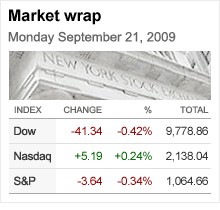
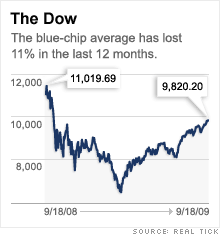


NEW YORK (CNNMoney.com) -- Falling commodity prices and financial shares dragged on blue chips Monday, keeping the market choppy after a more than six-month advance.
The Dow Jones industrial average (INDU) lost 41 points, or 0.4%. The S&P 500 (SPX) index lost about 4 points, or 0.3%. The Nasdaq composite (COMP) gained 5 points, or 0.2%, ending at a fresh one-year high.
Stocks managed to hit fresh 2009 highs Friday as investors continued to shake off calls for a September selloff. But with the major indexes up substantially since March, stocks are vulnerable to a pullback, analysts said.
Since bottoming at a 12-year low March 9, the S&P 500 has gained 58% and the Dow has gained 50%, as of Friday's close. After hitting a six-year low, the Nasdaq has gained 68%.
Stocks have risen during those 6-1/2 months due to slowly improving economic news and extraordinary amounts of fiscal and monetary stimulus. But analysts say that the run has been too much, too soon.
"The biggest challenge in the next few weeks and month is going to be corporate earnings," said Kevin Mahn, managing director at Hennion & Walsh.
He said that the profit reports as a whole are likely to be less upbeat than what some investors are looking for. "I think the disappointing earnings will be a validation that the recovery hasn't really started."
This could provide the catalyst for a modest pullback of 5% to 7% that would then bring back in buyers who have been waiting for a selloff to provide an in at lower levels.
This week: The Federal Reserve, meeting Tuesday and Wednesday, is likely to hold short-term interest rates steady at historic lows near zero. Last week, Fed chief Ben Bernanke said the recession is likely over but the labor market still has a long way to go.
Over the weekend, President Obama said that job growth won't kick in until the end of the recovery, sometime next year.
Also Tuesday, the Federal Housing Finance Agency (FHFA) releases its July home price index. Prices are expected to have risen 0.5% after rising 0.5% in June.
Reports on housing and consumer sentiment are due later in the week. On Thursday, the Group of 20 leading developed and emerging countries will meet in Pittsburgh to discuss the global economy in the wake of the recession.
Economy: The August index of leading economic indicators rose 0.6%, according to a report from the Conference Board released Monday. That was short of forecasts for a rise of 0.7%, according to a consensus of economists surveyed by Briefing.com. LEI rose 0.6% in July.
Company news: PC maker Dell (DELL, Fortune 500) is buying Perot Systems (PER), a provider of information technology services, in a $3.9 billion all-cash deal.
Dell shares fell 4% in Monday trading, while Perot Systems rose 65%.
AIG (AIG, Fortune 500) shares rallied 21% after a Congressional report said the company has stabilized although it was unclear whether it would ever be able to pay back its federal bailout. AIG received as much as $182 billion from Treasury and the Federal Reserve at different points in time over the last year.
Home builder Lennar (LEN) reported a wider quarterly loss Monday morning, but also said it will be profitable next year if the economy remains stable. Shares fell 3%.
Among the decliners, Dow financial stocks American Express (AXP, Fortune 500), Bank of America (BAC, Fortune 500) and JPMorgan Chase (JPM, Fortune 500) all declined.
Coca-Cola (KO, Fortune 500), McDonald's (MCD, Fortune 500), Caterpillar (CAT, Fortune 500), Chevron (CVX, Fortune 500) and Exxon Mobil (XOM, Fortune 500) were among the Dow's other losers.
Market breadth was mixed. On the New York Stock Exchange, losers beat winners two to one on volume of 1.20 billion shares. On the Nasdaq, decliners topped advancers seven to six on volume of 2.42 billion shares.
Currency and commodities: The dollar gained against the yen and euro, reversing its recent declines.
The rising greenback pressured dollar-traded commodities such as oil and gold.
U.S. light crude oil for October delivery tumbled $2.33 to settle at $69.71 a barrel on the New York Mercantile Exchange. COMEX gold for December delivery fell $5.40 to settle at $1004.90 an ounce. Gold hit a record high of $1,020.20 last week.
Bonds: Treasury prices rose, lowering the yield on the benchmark 10-year note to 3.47% from 3.46% Friday. Treasury prices and yields move in opposite directions.
World markets: Global markets tumbled. In Europe, London's FTSE 100, France's CAC 40 and Germany's DAX all slipped. Asian markets ended lower. 



