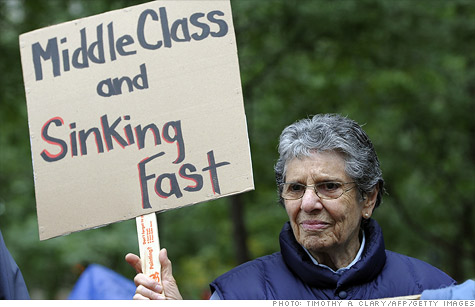
Household income for top 1% more than triples, while middle-class incomes grow by less than 40%.
NEW YORK (CNNMoney) -- From 1979 to 2007, average household income for the nation's top 1% more than tripled, while middle-class incomes grew by less than 40%, according to a new report from a research arm of Congress.
While those at the top have seen their incomes soar over the past three decades, middle-class and lower incomes have stagnated, the report by the Congressional Budget Office found.
"Over the past three decades, the distribution of income in the United States has become increasingly dispersed -- in particular, the share of income accruing to high-income households has increased, whereas the share accruing to other households has declined," the CBO said.
For the top 1% of the population, average inflation-adjusted household income grew by 275%. The rest of wealthiest fifth of the population, not including the top 1%, saw household income grow by 65% during that time, faster than the rest of the population, but "not nearly as fast as for the top 1%."
For middle-class earners, it was a different story.
Household income grew by just under 40% and the poorest fifth of the population saw their incomes rise by just 18% in a little less than 30 years, according to the study, which was based on IRS and Census data.
During that time, income ballooned at the top of the spectrum and government policy did less to redistribute wealth, the CBO found.
"The rapid growth in average real household income for the 1% of the population with the highest income was a major factor contributing to the growing inequality in the distribution of household income between 1979 and 2007," the report said. "Shifts in government transfers and federal taxes also contributed to that increase in inequality."
That's also, in part, what has spurred the recent Occupy Wall Street movement. Protesters refer to themselves as "the other 99%," which suggests that they represent a broad segment of the U.S. demographic, excluding the wealthiest 1% of Americans.
Their aim, they say, has been to bring attention to the country's growing economic gap.
Occupy Wall Street began on Sept. 17 in Manhattan's Financial District and has since grown into a global movement. 
| Overnight Avg Rate | Latest | Change | Last Week |
|---|---|---|---|
| 30 yr fixed | 3.80% | 3.88% | |
| 15 yr fixed | 3.20% | 3.23% | |
| 5/1 ARM | 3.84% | 3.88% | |
| 30 yr refi | 3.82% | 3.93% | |
| 15 yr refi | 3.20% | 3.23% |
Today's featured rates:
| Latest Report | Next Update |
|---|---|
| Home prices | Aug 28 |
| Consumer confidence | Aug 28 |
| GDP | Aug 29 |
| Manufacturing (ISM) | Sept 4 |
| Jobs | Sept 7 |
| Inflation (CPI) | Sept 14 |
| Retail sales | Sept 14 |