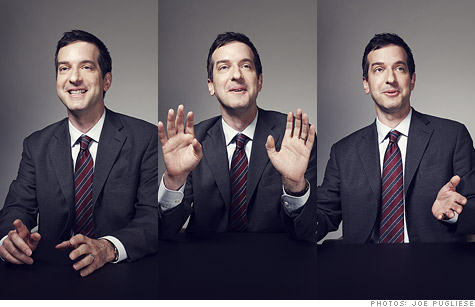
(MONEY Magazine) -- If, when you watch or read the financial news, you say to yourself, "This is crazy!" you'd often be right, says David Laibson, a Harvard economics professor.
Laibson's brain scans of people making difficult financial decisions, for example, have shown how hard-wired emotions can prevent investors from being the rational profit maximizers they need to be to invest wisely. One of the recent studies that Laibson was involved in used MRI brain images to prove that people are less emotional when it comes to making money-related decisions for others than when making moves that require their own immediate sacrifice.
Laibson says he sees evidence of some costly -- and common -- mental errors whenever he turns on the TV or attends a neighborhood party. But by realizing that you are prone to certain financial miscalculations, and that your financial wisdom has a life cycle of its own, you can take actions now to protect yourself in the future. Some of these moves may seem surprising. But put in the right context, they make perfect sense, he says.
What evidence of widespread financial miscues are you seeing now?
A terrific example: news reports and advertisements about gold. After a decade of spectacular returns, more and more people are piling in. This summer the gold ETF became the largest exchange-traded fund in the market, surpassing ones that track the Standard & Poor's 500!
What we have here is a classic example of people chasing the trend -- of mistakenly thinking that what has happened in the recent past will reproduce itself in the near future. I fear it is going to end badly.
How dangerous is it for investors to assume that recent patterns will repeat themselves?
The danger is very clear. A lot of people are mistakenly terrified of equities. They rightly recognize that equities are volatile. But they mistakenly conclude that because equities are volatile, they want no part of them. They end up overwhelmingly holding bonds in their 401(k) plans. I would urge them to rethink that for two reasons.
First, historically equities have offered a large premium over bonds. Now, this overperformance is not guaranteed, but it is our best guess of what is going to occur in the future.
Second, we should all be thinking about our total wealth. Your wealth is not just your 401(k). You've got Social Security. You've got your house. You've even got some labor income. The assets that I just described tend to be more like bonds than like equities.
Suppose I want a 33% allocation to stocks. But my 401(k) is one-third of my wealth. So if I want a 33% equity allocation, what fraction of my 401(k) do I have to put into stocks? One hundred percent. Thinking that way is called "broad framing." People don't think that way.
The value of my house has fallen 30%! It isn't like a nice, safe bond. And except for tenured professors, workers face a volatile job market. Why wouldn't I want more security when it comes to my savings?
You're right that assets like your house and labor income do not provide certain returns. But they're not like equities in the sense that their returns aren't highly correlated with stock gains.
So older investors do need some exposure to bonds, right?
Absolutely. When you retire, you're not getting any more labor income, so you want to shift more into bonds as you age -- though, in my view, not as radically as most target-date retirement funds do.
You mentioned "broad framing." What's the correct frame with which investors should be allocating their 401(k)s?
Think about the U.S. in the world economy. The U.S. accounts for about a quarter of the world's output, but most of us end up putting almost all of our net worth into assets that are closely tied to the fortunes of the domestic economy.
For example, your house and your Social Security assets are tied to the U.S. economy. When you think about it that way, your only opportunity for foreign exposure is through your 401(k). If your 401(k) is one-third of your assets, and you put 75% of your 401(k) into assets with foreign exposure, you still only have one-quarter of your total assets exposed internationally.
Now, you can get some overseas exposure from shares of U.S. multinationals. But I would urge people to go beyond this. Investors need lots of international investments in their 401(k)s to obtain even a modest level of foreign exposure in their total portfolios.
The overseas markets have been hammered by the potential collapse of European debt and accounting scandals in Asia. Why put more money in these markets?
It is true that as we get further away from well-regulated markets, international investing becomes a problem. I recommend buying publicly traded securities only in well-regulated markets. And the bad news about Europe is already priced into securities.
A surprising piece of advice: You've said if workers have to borrow, the cheapest and best way is often through their 401(k)s.
Well, borrowing against a 401(k) could be a backdoor way of getting at money and spending it too early. But when my collaborators and I look at the data, we find that most of those loans are getting repaid. Would you rather pay a credit card company 18%, or would you rather borrow from yourself?
Still, if you lose your job, you may have trouble paying back that loan.
You'll have trouble repaying whether you have a 401(k) loan or whether you have a credit card balance. If you lose your job and get into financial trouble, the credit card company will come after you.
On the other hand, if you have a 401(k) loan and can't repay it, you'll pay a 10% penalty. It is true that when some people leave a company, they don't repay their 401(k) loans. That "leakage" is hurting some households' retirement savings. But credit card balances, carried at an 18% rate of interest, tend to hurt financial health even more.
Turning to another facet of your research, you think people hit a financial intelligence peak at 53.
Fifty-three isn't a magic number. And we certainly aren't perfect at 53. But we do tend to be a lot better at 53 than at 83. Half of the U.S. population in their eighties has dementia or another form of significant cognitive impairment. We need to come to terms with that and create an environment that is safe.
This is one area where you think that the retirement system itself is irrational and dangerous.
It is terrible. Unbelievable. We have this odd system in which people who need the most protection -- the elderly -- have less protection than the 50-year-old. During their working life, people will typically be accumulating savings in a 401(k), in which their employer, the so-called plan sponsor, is legally obligated to put beneficiaries' interests first.
But for the retired 85-year-old, unless they stayed in that 401(k), which few of them do, it is like the Wild West. People at that advanced age are particularly vulnerable and need the protections even more than folks in their fifties.
Knowing this, how can people protect themselves?
If you know that you are going to be at your financial peak performance in your fifties, that's when you should set your financial life in order. Older folks should think about asking their kids to help them with their financial planning.
Any advice on how we can nudge our parents to seek this help?
The thing that I would try to tell them is, "This is just what people who have their acts together do at 65." It should be about empowering the parent to make these decisions for him- or herself. 

Carlos Rodriguez is trying to rid himself of $15,000 in credit card debt, while paying his mortgage and saving for his son's college education.

Susan Carson and Laura DeLallo make $225,000 and have half a million in retirement savings, but their sprawling portfolios is proving hard to manage.
| Overnight Avg Rate | Latest | Change | Last Week |
|---|---|---|---|
| 30 yr fixed | 3.80% | 3.88% | |
| 15 yr fixed | 3.20% | 3.23% | |
| 5/1 ARM | 3.84% | 3.88% | |
| 30 yr refi | 3.82% | 3.93% | |
| 15 yr refi | 3.20% | 3.23% |
Today's featured rates: