
CNNMoney.com
Companies Economy International Corrections Pre-market trading After-hours trading Winners/losers/actives Bonds Currencies Commodities Money Magazine Retirement Mutual Funds Taxes Ask the Expert Money 101 Autos Loan Center Best Places to Live Calculators Mortgage Rates Personal tech Big Tech blog Techland blog Sectors and stocks Fortune 500 techs Tech Talk 100 best places to launch Ultimate resource guide Small biz makeovers FSB 100 Fortune 500 Technology Investing Management Rankings Main Create portfolio Edit portfolio Create Alerts Edit Alerts

A midlife money checkup

Are you still on pace to reach your goals despite today's market woes? Find out by taking this nine-step test of your financial health. It won't hurt a bit.

1. Are you saving enough for retirement?

DO IT NOW
To cope with a volatile market like today's, leave your emotions on the sideline. Steadily add money to stock funds through your 401(k) or an automatic investment plan. In 2008 you can put $15,500 in a 401(k) and $5,000 in an IRA. If you are 50 or older, you can invest an additional $5,000 in a 401(k) and $1,000 in an IRA.
1. Are you saving enough for retirement?
When you're just starting to save and invest, this question is hard to answer with any precision. Who knows how much money you'll need in retirement when those days are eons away? Now that you're in your forties or fifties, it's easier to make an educated guess.

You have a 401(k) balance or other plans you can check on (if you can bear to look today). And you probably know how long you want to keep working and have an idea of what you want to do afterward - travel, launch a second career, kick back. You still have time to refine your goals. But as retirement draws closer, you can't put off creating a concrete savings target and measuring your progress.

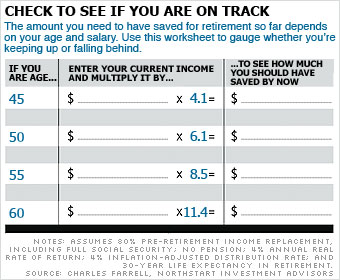
One way to look at this is to come up with the Big Number. As a rule of thumb, figure you'll live on 80% of your pre-retirement income when you stop working. So if you make $100,000, that's a retirement income of $80,000. If you assume you have no pension and that you'll collect $20,000 a year from Social Security (get an actual estimate at ssa.gov), the remaining $60,000 will come out of your savings.

The standard financial planning advice is that you can safely withdraw up to 4% of your assets in the first year of retirement. You then increase that amount each year to match inflation. So in this example you'll need to amass $1.5 million by the time you quit ($60,000 divided by 0.04, if you're keeping track at home).

Work up your own Big Number and an annual savings goal with our retirement calculators. You can also use the worksheet to the right to see where you should be by now. Whether you're on target or behind, remember to keep saving. It may seem hard to buy when the market is stumbling, but think of it as a 10%-off sale on stocks you have to buy anyway.
Last updated February 11 2008: 1:33 PM ET

Get started

Save

Diversify

Select

Owe

Will

Inherit

Insure

Rethink

Take care
In the years ahead, five key trends will dominate your financial life. The message: So far you've been lucky, baby boomer. Now it's time to be smart. (more)
The looming reality of senior citizen status scares a lot of boomers. No need. Laura Carstensen, a top expert on aging, says life gets only richer with time. (more)
Sure, you want to give them a boost in life. But for both your sake and your kids', you have to cut the financial cord sometime. Here's how. (more)
© 2008 Cable News Network. A Time Warner Company. All Rights Reserved. Terms under which this service is provided to you. Privacy Policy
Copyright © 2008 BigCharts.com Inc. All rights reserved. Please see our Terms of Use.
MarketWatch, the MarketWatch logo, and BigCharts are registered trademarks of MarketWatch, Inc.
Intraday data delayed 15 minutes for Nasdaq, and 20 minutes for other exchanges. All Times are ET.
Intraday data provided by ComStock, an Interactive Data Company and subject to the Terms of Use.
Historical, current end-of-day data, and splits data provided by FT Interactive Data.
Fundamental data provided by Hemscott.
SEC Filings data provided by Edgar Online Inc..
Earnings data provided by FactSet CallStreet, LLC.
* : Time reflects local markets trading time.† - Intraday data delayed 15 minutes for Nasdaq, and 20 minutes for other exchanges.• Disclaimer