
The return of the homebuilders
Two bellwethers are pointing toward a recovery. That's good news for some undervalued stocks.



NEW YORK (Fortune) -- Is it finally time to buy homebuilder stocks? The basic math of the real estate market is now working in favor of an industry that, believe it or not, has done a remarkable job paring costs and harboring its financial strength for the recovery that's now dawning.
The two main bellwethers for housing's future - the supply/demand equation and affordability - are both pointing towards a recovery. The timing is impossible to predict, though the best guess is that home sales will stage a resurgence beginning late this year or in early 2010.
Fundamental demand is driven by household formation, which in turn depends on two factors: the rate of immigration and the number of Americans entering the labor market. Distilling all the data, the Congressional Budget Office reckons that new households can absorb around 1.5 million new houses, condos and rental units a year.
But from 2003 to 2006, housing starts averaged over 1.9 million units, peaking at an astronomical 2.3 million in early 2006. Hence, the flood of new homes far exceeded the number of families joining the labor force each year who could actually live in them. By mid-2008, the CBO reckoned that the U.S. suffered from an oversupply of 1.7 million units, dwarfing all previous records.
Fortunately, the market is working with ruthless efficiency to shrink the oversupply. In the second half of 2008, housing starts fell to an average annual rate of 770,000 units; so far this year, the figure is around 500,000.
Since the number of new homes and apartments now isn't nearly big enough to accommodate the immigrants and young workers crowding the labor force, residents are buying and renting the existing units (albeit at a slow pace). That's driven the excess inventory down to less than 900,000 units. At the present slow pace of homebuilding, the glut will disappear by the end of 2009.
The other force behind the housing rebound: Call it the "New Affordability." According to the most recent Case/Shiller data, prices in many of the bubble markets have fallen at least 40% from their peaks. The declines are drawing people out of rental and into the home-buying market.
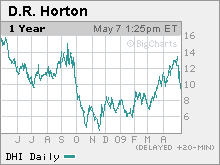
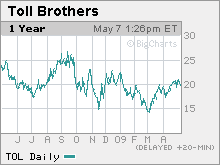
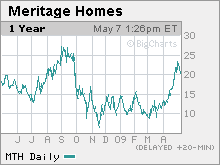
That's good news for homebuilders, and all the major homebuilder stocks have rallied off the multi-year lows they hit in March: Toll Brothers is up 50%, and D.R. Horton 100%, for example. Fortunately, they and some others are still bargains. Here are three that cover a range of products and geography and are especially attractive.
D.R. Horton (DHI, Fortune 500) America's biggest homebuilder specializes in the market's sweet spot: starter homes for first time homebuyers. Those customers don't need to sell their existing home to buy one of Horton's - they typically move straight from a rental.
Horton is also a hawk on costs, and it recently reduced interest expenses by retiring over $500 million in debt.
Toll Brothers (TOL) At first glance, Toll would seem an unlikely pick since it specializes in mass-produced, luxury market of homes at $600,000 and up. But the stock is selling at a substantial discount to its peers (based on price-to-book-value).
The company also boasts a strong balance sheet, and CEO Bob Toll is expert at buying distressed properties at bargain prices, a skill he displayed in the early 1990s. Toll may rebound later than Horton, but when the credit markets finally loosen up and lenders aren't so shy about handing out mortgages, it is bound to benefit as first and second-time buyers move up to more expensive homes.
Meritage Homes (MTH) Meritage derives half its sales from Texas, one of the fastest growing states in the country. It's shrewdly changing its specialty from almost $300,000 send-and-third move up homes to starter houses priced at around $200,000.
It's also expert at shrinking the size of its houses to keep them affordable. Result: Meritage is one of the most successful homebuilders at competing with foreclosures. 


-
 The retail giant tops the Fortune 500 for the second year in a row. Who else made the list? More
 -
 This group of companies is all about social networking to connect with their customers. More
 -
 The fight over the cholesterol medication is keeping a generic version from hitting the market. More
 -
 Bin Laden may be dead, but the terrorist group he led doesn't need his money. More
 -
 U.S. real estate might be a mess, but in other parts of the world, home prices are jumping. More
 -
 Libya's output is a fraction of global production, but it's crucial to the nation's economy. More
 -
 Once rates start to rise, things could get ugly fast for our neighbors to the north. More









