
Recession is over, says economist
According to Dennis Gartman, a number of indicators point to a recovery that is just getting started.



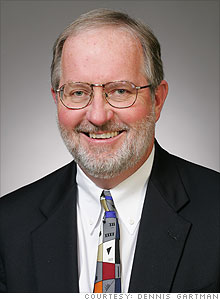 |
| Dennis Gartman: "It's over." |

NEW YORK (Fortune) -- When economist Dennis Gartman told subscribers of his newsletter in the fall of 2007 that the U.S. was entering a recession, the Dow was at 13,500, and the official government call wouldn't come for another full year.
Now he's ahead of officials and forecasters again. According to Gartman, the U.S. recession that started in December 2007 is done.
"We saw it happen two weeks ago -- it's over," he said in a recent interview.
Other well-known economists and market watchers have recently been hinting at the same thing. NYU economics professor Nouriel Roubini, also known as "Dr. Doom" for his prescient predictions of the worldwide downturn, says the U.S. recession will end later this year. Treasury Secretary Timothy Geithner said last weekend that the recession is easing. And President Obama told Univision last week, "We maybe are beginning to see the end of the recession."
But Gartman says the Great Recession ended in July.
"Too many people get too arcane and have too many arguments about why an economy goes into or comes out of a recession," he says. "Having done this for 35 years, I've fallen into using just a couple of indicators that characteristically have done a very good job."
The first is a spike downward in the number of weekly jobless claims, which unlike the unemployment rate, focuses on newly laid off workers. Gartman doesn't seek a specific percentage decline (such as when a 20% decline denotes a bear market), but instead he waits for a sharp downward trend. "It's like the definition of pornography: I'll know it when I see it," he says.
He saw that downward spike last month. Weekly jobless claims rose to 658,000 in the first week of March but have since declined to a seasonally adjusted 584,000 for the week ending July 25. "That's enough of a spike," says Gartman, who considers the recent declining 4-week average of jobless claims -- the less volatile average recently reached its lowest point since January -- to be "icing on the cake.''
Gartman then looks at a ratio from The Conference Board: the percentage of coincident economic indicators to lagging indicators.
The ratio measures changes in the economy by dividing coincident (or real time) economic indicators like industrial production and personal income by lagging indicators, like the unemployment rate. So, if during a recession coincident indicators increase at a faster clip than lagging indicators, the economy is expanding and the ratio rises.
As Gartman notes, that ratio has been rising three months in a row. It increased to 90.5 in June from 89.4 in March. According to Gartman and Conference Board data, the fall in jobless claims and a rise in the ratio correlate with the end of recessions since 1959.
Gartman can't say why these two metrics out of hundreds of other have corresponded so well with economic recoveries. "I'm not one to get caught up in the explanation of things if I see the correlations hold," he says, noting that they poorly predict the beginning of recessions.
He expects economic indicators to slowly turn positive by October, but he's careful to remind investors that "the news is horrible at the bottom of a recession. It's going to be terrible for another couple months." Because it's a lagging indicator, Gartman expects unemployment to rise into 2010.
Critics could argue that Gartman's model would have a hard time holding up in the worst recession in more than 70s years -- after all, the Conference Board's ratio didn't even exist in the 1930s. But he's standing firm on its consistency.
"Every time can be different," he explains, "but they very rarely are. Every time you bet on something being different, you pay dearly for it." 


-
 The retail giant tops the Fortune 500 for the second year in a row. Who else made the list? More
 -
 This group of companies is all about social networking to connect with their customers. More
 -
 The fight over the cholesterol medication is keeping a generic version from hitting the market. More
 -
 Bin Laden may be dead, but the terrorist group he led doesn't need his money. More
 -
 U.S. real estate might be a mess, but in other parts of the world, home prices are jumping. More
 -
 Libya's output is a fraction of global production, but it's crucial to the nation's economy. More
 -
 Once rates start to rise, things could get ugly fast for our neighbors to the north. More









