
Feasting on failed banks
Big banks are scooping up troubled, smaller institutions at a time when growth is hard to come by -- and thanks to favorable FDIC rules, more deals are likely.



NEW YORK (Fortune) -- Shares of BB&T Corp. shot higher Friday after reports that it might be scooping up the remains of Colonial BancGroup.
It's no wonder: Such purchases give healthier banks a chance to grow on the cheap. That's valuable at a time when many institutions have been shrinking in response to the recession.
More than 70 banks have failed this year. Scores of additional failures are expected in coming years, as the industry works through trillions of dollars worth of residential and commercial real estate problems.
While most of the biggest recent bank failures have been resolved via sales to major institutions or investor groups, regional banks have been bulking up as well.
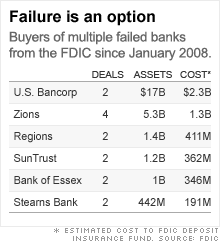
Since the banking crisis started last year, six regional banks have bought at least two failed banks from the FDIC. The leader has been Zions Bancorp (ZION), a Salt Lake City-based institution that has acquired four banks from the FDIC.
Other buyers of multiple troubled banks include U.S. Bancorp (USB, Fortune 500), the Minneapolis-based bank that last year bought the remains of troubled thrifts Downey Savings and PFF, which failed on the same day. The joint purchase of Downey and PFF wound up being the third largest deal by assets for failed banks last year, after the WaMu and IndyMac sales.
FDIC rules require the agency to resolve bank failures in the manner that's least costly to the deposit insurance fund. The deposit fund is backed by fees paid by banks, but the FDIC has a credit line with the Treasury Department that it could tap in an emergency.
The rash of failures over the past year and a half has come at heavy cost to the fund, which is now 75% below its statutory minimum balance.
The cost to the FDIC fund in the U.S. Bancorp and Zions deals alone was $3.6 billion. The agency also agreed to so-called loss-sharing agreements on some of the transactions, which means the fund could end up shouldering additional costs on troubled assets taken on by the acquirers.
It's this provision -- capping the acquirer's losses at the expense of the fund -- that is most alluring to regional banks and their investors.
In addition to BB&T (BBT, Fortune 500), analysts have pointed to Cincinnati's Fifth Third (FITB, Fortune 500) and Atlanta's SunTrust (STI, Fortune 500) as regional banks that might be chosen to participate in future deals.
Some bankers have downplayed questions about buying failed institutions. Such deals "really are off our radar," Fifth Third chief executive officer Kevin Kabat told investors last month, noting that there have been relatively few bank failures in the Midwest.
But given the advantageous terms, no one is ruling FDIC-assisted deals out, either.
U.S. Bancorp chief executive officer Richard Davis said in a conference call with analysts and investors last months that the bank "will always be available" for any "opportunities that come along" on the FDIC failed bank list, though it is keeping an eye out for bigger ones. 


-
 The retail giant tops the Fortune 500 for the second year in a row. Who else made the list? More
 -
 This group of companies is all about social networking to connect with their customers. More
 -
 The fight over the cholesterol medication is keeping a generic version from hitting the market. More
 -
 Bin Laden may be dead, but the terrorist group he led doesn't need his money. More
 -
 U.S. real estate might be a mess, but in other parts of the world, home prices are jumping. More
 -
 Libya's output is a fraction of global production, but it's crucial to the nation's economy. More
 -
 Once rates start to rise, things could get ugly fast for our neighbors to the north. More









