
WaMu: The forgotten bank failure
The biggest-ever bank collapse didn't lead to chaos, but Americans will pay the price for its unsound lending for years to come.



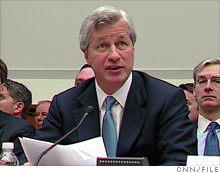 |
| JPMorgan, led by chief Jamie Dimon, bought WaMu's banking assets. |

NEW YORK (Fortune) -- Washington Mutual is long gone, but its lax lending could haunt us for years.
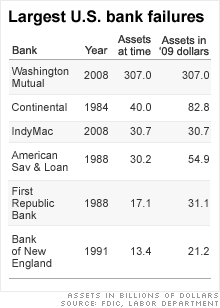
The Seattle-based institution collapsed in the largest-ever U.S. bank failure last September. WaMu ran out of cash after business customers, unnerved by the implosion of Lehman Brothers, withdrew their uninsured deposits.
After the chaos surrounding Lehman's demise, WaMu was put to rest with little fuss. Regulators seized the nation's sixth-biggest bank on a Thursday night -- a departure from the customary Friday -- and sold it to JPMorgan Chase (JPM, Fortune 500) for $1.9 billion.
The move wiped out WaMu's 56,000 shareholders of record and left bondholders nursing billions of dollars in losses. But the WaMu deal spared the federal deposit insurance fund and thus was, unlike so many federal actions over the past year, an unalloyed positive for taxpayers.
"That was a good outcome," said Chip MacDonald, a banking lawyer at Jones Day in Atlanta. Given the financial panic that followed Lehman's collapse and the rescue of AIG (AIG, Fortune 500), he said, "it could have gone the other way."
Even so, Americans will be paying for some years for the ill-advised loans made earlier this decade by WaMu and like-minded peers such as Wachovia.
Defaults on the exotic mortgages the firms specialized in have been high, and they could rise even further in coming months as payments jump for some borrowers. That should add to the stress on the banking system, in the housing markets and in foreclosure-riddled communities.
"We're still waiting to see how the Wachovia and Washington Mutual portfolios play out," said Brian Olasov, who studies the banking industry as managing director at law firm McKenna Long & Aldridge. "We've got a big bulge in resets still to come."
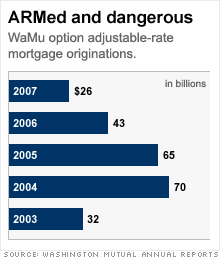
WaMu and Wachovia, now part of Wells Fargo (WFC, Fortune 500), helped stoke the housing bubble by issuing tens of billions of dollars of so-called option adjustable rate mortgages. Option ARMs, as they are known, were typically made with little or no documentation and allowed borrowers to underpay in early years -- at the expense of much higher monthly payments later.
These loans helped inflate the housing bubble in then-hot markets such as California by allowing borrowers to stretch well beyond their incomes to bet on house price gains.
When the market turned, these loans began defaulting at a rapid clip, leaving the lenders with huge losses. JPMorgan took $31 billion in writedowns when it acquired WaMu, and Wells took a $24 billion hit on its Wachovia loans when it completed that purchase.
The writedowns will limit the damage to the banks. But that may not prevent borrowers from having their loans reset to higher interest rates or "recast" to higher monthly payments, based on the rate at which principal is paid down.
Some $700 billion of option ARMs were written in the U.S. between 2004 and 2007. Most option ARMs are set to recast after five years -- meaning that the first wave of higher payments is hitting borrowers this year.
WaMu -- which wrote $133 billion worth of option ARMs when house prices were at their peak between 2005 and 2007 -- said in its annual report last year that 13% of its option ARM loans are due to recast this year. The bulk of recasts are due to take place between next year and 2012.
Recasts often lead to defaults because the banks' option ARM portfolios embody the worst aspects of the housing bubble.
Wachovia, which acquired its option ARM portfolio in its misguided 2006 acquisition of California thrift Golden West Financial and made the loans under the Pick-a-Pay brand, had $120 billion of Pick-a-Pay mortgages on its books at the end of 2007.
Two-thirds of Wachovia's Pick-a-Pay loans were made in the bubble states of California and Florida, which have suffered from the steepest price declines and the highest foreclosure rates. Two-thirds of borrowers as of Dec. 31 were using the minimum payment option -- the one that results in their paying less than the full amount of interest due and having the balance added to the loan. Six loans in seven were written without documenting the borrower's income or assets.
Option ARMs written by all banks largely share those features, though Wachovia's loans stand out in one important way: they aren't scheduled to recast until they are 10 years old, which should keep low monthly payments in place into the middle of next decade.
Accordingly, Wells Fargo said in its annual report this year that it expects recasts on just $106 million of loans in 2009 and 2010, and $316 million in 2011-2012.
Still, Wachovia was just one player in a once-crowded field that included the likes of Countrywide, now owned by Bank of America (BAC, Fortune 500), and BankUnited and IndyMac -- two of the biggest bank failures of the past two years.
And while officials have been trying to get lenders to modify mortgages to slow the foreclosure surge, real progress has been hard to come by.
"A lot of people are going to be facing payment shock," said Olasov. "There's a lot of troubled real estate debt in the banks, and there's no easy answer." 


-
 The retail giant tops the Fortune 500 for the second year in a row. Who else made the list? More
 -
 This group of companies is all about social networking to connect with their customers. More
 -
 The fight over the cholesterol medication is keeping a generic version from hitting the market. More
 -
 Bin Laden may be dead, but the terrorist group he led doesn't need his money. More
 -
 U.S. real estate might be a mess, but in other parts of the world, home prices are jumping. More
 -
 Libya's output is a fraction of global production, but it's crucial to the nation's economy. More
 -
 Once rates start to rise, things could get ugly fast for our neighbors to the north. More









