
Rx for money woes: Doctors quit medicine
Some physicians, fed up with the costs of their practice, are ready to hang up their stethoscopes and shift careers.



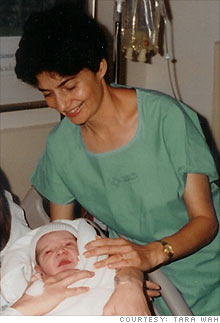 |
| Dr. Tara Wah closed her ob/gyn practice in Tallahassee, Fla., last year, saying that she could no longer "afford" to stay in business. Wah currently is not practicing medicine. |

- Shady insurance: Insider's take
- Health insurance nightmare
- Health insurance: My biggest gripe
- Obama's ex-doctor: Insurers 'screwing' it up
- How insurers meddle in your care
- Rx for money woes: Doctors quit medicine
- The fear factor in health care costs
- Doctors slash vaccines due to rising costs
- Doctor's orders: Avoid insurance

NEW YORK (CNNMoney.com) -- Some 5,000 patients suddenly found themselves without an ob/gyn last November when Dr. Tara Wah closed her practice in Tallahassee, Fla.
Wah, 55, informed her patients in a letter that she could "no longer afford to make ends meet."
After 24 years, "I'm working longer hours than ever," she wrote. "Insurance payments for patient care have stayed virtually the same for the last 15 years, while the cost of doing business, including health insurance, staff salaries and supplies have risen."
The rising cost of malpractice insurance, particularly for her specialty, was the straw that broke the camel's back.
"My malpractice insurance was $125,000 a year, and going up," said Wah. "The only way to get the extra money was to cut back on my salary."
But it wasn't always like that. Being a doctor was once thought to be a path to a cushy lifestyle. Six years after she started practicing, Wah hit her "peak" income year in 1990. Then she took a pay cut every year from 1993 onward, to eventually take no salary for two months prior to permanently shutting her office.
Wah no longer practices medicine. Instead, she designs and repairs jewelry. "I feel guilty. I dream about [medicine]," she said. "[But] I am so angry. I think, 'What a waste of my training.' "
Wah's situation sheds light on a troubling trend of physicians leaving medicine for a career outside of health care, said Kurt Mosley, a staffing expert with Merritt Hawkins & Associates, a physician search and consulting firm.
A first-ever survey of 12,000 primary care physicians conducted last October by Merritt Hawkins and the Physicians' Foundation, an organization that represent the interests of physicians, showed that 10.1% of respondents planned to seek a job outside of health care in the next one to three years.
"That is a big number. It's just very sad," said Mosley, especially in light of the shortage of primary care doctors in the United States today.
The American Medical Association said it is aware of this trend, citing the survey, but said it does not have data to show how many doctors have already prematurely exited the profession.
Regardless, Mosley said it's a waste of training, skill, talent and money when a doctor leaves the profession in mid-career.
It takes a minimum of 10 to 12 years of training to become a doctor. In Wah's case, she underwent 10 years of training, including medical school and residency, before she entered the workforce.
While some enter medicine because they believe it pays well, most choose it as a career because they feel it's their calling.
"For many it's not about the money. They have a passion for it, to take care of people," said Mosley. "It's not easy to feel that passionately for another career after medicine."
It's also a waste of taxpayer money when a physician opts out. "We are all paying out of our pockets to produce doctors," said Mosley.
That's because medical residency programs are mostly funded by Medicare to the tune of $9 billion to train about 100,000 residents annually, according to the Medicare Payment Advisory Commission.
"It's Medicare that funds hospital costs to house residency programs, pay salaries of residents and sometimes pay faculties' salaries," said Mosley.
Dr. Patricia Perry, 44, a dermatologist based in Burbank, Calif., operates a solo practice. She mostly performs medical procedures such as skin biopsies.
Perry said she's "seeking to get out" of her profession because she's fed up with insurance reimbursement challenges while struggling to cover other costs associated with being a doctor.
"When you get to a point where you feel unappreciated and you're arguing with people about being paid, it takes away the passion for what you do," Perry said.
Daryl Richard, a spokesman for insurer UnitedHealthcare (UHC), said his company is taking steps to address some of providers' concerns.
"We agree 100% that there is too much paperwork" tied to reimbursement claims, he said.
Richard said UnitedHealthcare offers a Web-based application to all of its providers that will enable the company to adjudicate claims to determine a reimbursement and a patient's out-of-pocket expense "by the time the patient makes it to the (doctor's) front desk."
"This takes away some of the unknown for both providers and consumers," he added.
Perry pays $2,500 a year in malpractice insurance. "I am licensed in three states. To maintain my license I have to pay a fee every one to two years in each state," she said. She also pays a considerable amount of money every year to attend annual trade conferences required by her specialty to update and hone her skills.
She said many physicians are scared to speak out about their money woes because they don't want to be perceived as "greedy."
"I have news for you. You are already being perceived that way," she said.
Dr. Kenneth Cohn, a general surgeon with an MBA who tours the country advising doctors on non-clinical job options, says there's a high-level of angst among U.S. physicians. "There's absolutely a greater number who are looking for other job opportunities," he said.
It's a reality that we have to deal with, Cohn said. The implication of it on the health care system, he said, is that doctors may have to increasingly use nurse practitioners and physicians assistants to fill in the gaps. They may also need to look to newer delivery concepts such as medical homes, in which doctor take more of a managerial role in a patient's health care.
Dr. Douglas Evans, 50, a pediatrician based in St. Joseph, Mo., said he's considering a mid-career change if insurer-provider relations aren't reformed.
"I had a young football player in my office [this week]. His symptoms indicate a problem with his neck," he said in an example. "But I have to get authorization from his insurance company first to get an X-ray or an MRI. It's an example of how insurance companies dictate to me what I have to do."
Evans is frustrated that this process will delay treatment by several days.
"My first concern is that he's young and has his career in front of him," he said. "My second concern is that there's a predatory lawyer out there," meaning that if his patient's condition worsens while he waits to get authorization, it could expose him to a malpractice suit.
And Evans said insufficient reimbursement from insurers is posing a heavy financial burden on his practice.
"You can't go to Wal-Mart (WMT, Fortune 500) and pay half the price for a loaf of bread and take the whole bread," he said. Still, he said many doctors have a hard time turning away patients for this reason alone, and end up absorbing the costs.
He warns that unless things improve, only those providers who can't afford to do something else will be left in the system. "I am looking for something that's still science related, like teaching biology at a university," said Evans.
Wah is disillusioned and disappointed, but maybe not completely bitter.
"For the young doctors who are just getting started, I want to say don't give up," she said.
"After taking some time off , I might be able to do some volunteer work," she said. "I do love medicine, but I'm not [mentally] in a place right now to come back." 



