NEW YORK (CNNMoney.com) -- It's officially official.
The Obama administration on Friday said the government ran a $1.42 trillion deficit in fiscal year 2009.
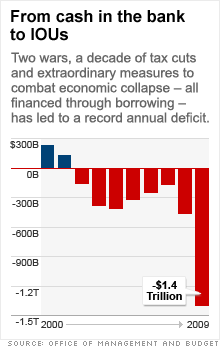
That made it the worst year on record since World War II, according to data from the Treasury and the White House Office of Management and Budget.
Tax receipts for the year fell 16.6% overall, while spending soared 18.2% compared to fiscal year 2008. The causes: rising unemployment, the economic slowdown and the extraordinary measures taken by lawmakers to stem the economic meltdown that hit in fall 2008.
Consequently, the annual deficit rose 212% to the record dollar amount of $1.42 trillion, from $455 billion a year earlier.
As a share of the economy, the deficit accounted for 10% of gross domestic product, up from 3.2% in 2008. As breath-taking as that may be, it's still not in the same stratosphere as the 1945 deficit, which hit 21% of GDP.
Fiscal year 2009, which ended Sept. 30, had all the right ingredients for a record-breaking deficit.
While tax revenue overall took a big hit, corporate receipts led the way, falling 55%. Individual income tax revenue fell 20%.
At the same time spending jumped in large part because of the various economic and financial rescue measures undertaken. The Treasury and the OMB noted that the $700 billion Troubled Asset Relief Program and the $787 billion American Recovery and Reinvestment Act, not all of which has been used, accounted for 24% of the deficit total.
As a result, the country is very near to breaching its so-called debt ceiling, currently set at $12.1 trillion. Lawmakers, however, are expected to vote to raise that ceiling this fall.
At the end of September, the country's total debt -- which is an accumulation of all annual deficits to date plus other obligations -- stood at $11.9 trillion.
In August, the OMB projected a 10-year deficit of $9 trillion, assuming President Obama's 2010 budget proposals are put in place.
A deficit of that magnitude means the debt held by the public would approach 82% of gross domestic product. That's double the 41% recorded in 2008.
Most budget experts blanch at the thought, especially given that the country's fiscal future was already a source of concern before the economic crisis because of expected shortfalls over time in funding for Medicare and Social Security.
The financial and economic meltdowns of the past year have accelerated the strain on federal coffers. So much so that now the 10-year forecast as well as the longer-term outlook are considered unsustainable, according to deficit experts William Gale and Alan Auerbach.
In a report this week, the Government Accountability Office noted that the deficits born from the financial crisis are not the biggest crux of the problem.
"While a lot of attention has been given to the recent fiscal deterioration, the federal government faces even larger fiscal challenges that will persist long after the return of financial stability and economic growth," the GAO said.
The GAO further cautioned that the yawning deficit problems should be addressed sooner rather than later.
"The longer action to deal with the nation's long-term fiscal outlook is delayed, the larger the changes will need to be, increasing the likelihood that they will be disruptive and destabilizing."
The Obama administration is promising to put a plan in place to lessen the deficit when the economy recovers.
"It was critical that we acted to bring the economy back from the brink earlier this year. As we move from rescue to recovery, the president recognizes that we need to put the nation back on a fiscally sustainable path," said OMB director Peter Orszag in a statement. "As part of the FY2011 budget policy process, we are considering proposals to put our country back on firm fiscal footing." 







| Index | Last | Change | % Change |
|---|---|---|---|
| Dow | 32,627.97 | -234.33 | -0.71% |
| Nasdaq | 13,215.24 | 99.07 | 0.76% |
| S&P 500 | 3,913.10 | -2.36 | -0.06% |
| Treasuries | 1.73 | 0.00 | 0.12% |
| Company | Price | Change | % Change |
|---|---|---|---|
| Ford Motor Co | 8.29 | 0.05 | 0.61% |
| Advanced Micro Devic... | 54.59 | 0.70 | 1.30% |
| Cisco Systems Inc | 47.49 | -2.44 | -4.89% |
| General Electric Co | 13.00 | -0.16 | -1.22% |
| Kraft Heinz Co | 27.84 | -2.20 | -7.32% |
|
Bankrupt toy retailer tells bankruptcy court it is looking at possibly reviving the Toys 'R' Us and Babies 'R' Us brands. More |
Land O'Lakes CEO Beth Ford charts her career path, from her first job to becoming the first openly gay CEO at a Fortune 500 company in an interview with CNN's Boss Files. More |
Honda and General Motors are creating a new generation of fully autonomous vehicles. More |
In 1998, Ntsiki Biyela won a scholarship to study wine making. Now she's about to launch her own brand. More |
Whether you hedge inflation or look for a return that outpaces inflation, here's how to prepare. More |




