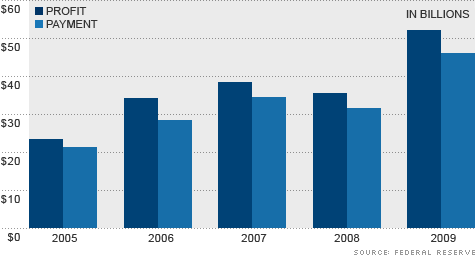
NEW YORK (Fortune) -- The Federal Reserve banks made a $52 billion profit in 2009, reaping extra income on the government securities they bought in an effort to stabilize the financial system.
The Fed, in a statement on Tuesday, said its members returned $46 billion of that sum to taxpayers. The central bank is an independent arm of the government and its member banks are required to return all profits to the Treasury, after certain deductions.
Those deductions account for the $6 billion difference between the two figures. Federal Reserve banks paid the private banks that control them $1.4 billion in dividends in 2009, while shoring up their own capital by $4.6 billion.
The Fed's 2009 profit marks a 47% increase over 2008. It comes as the Fed took in interest payments on an expanding portfolio of securities issued by the Treasury and by the government-sponsored mortgage agencies Fannie Mae (FNM, Fortune 500) and Freddie Mac (FRE, Fortune 500).
The Fed said last year it would buy $300 billion of Treasurys and up to $1.25 billion of agency mortgage-backed securities, in addition to $175 billion of debt issued by the agencies.
The effort helped to keep mortgage and other long-term interest rates low as the government sought to help the economy recover from the worst financial crisis since the Great Depression. It also brought a flood of profits into the vaults of the 12 Federal Reserve banks.
But the purchases also more than doubled the size of the Fed's balance sheet, leading to questions about the possible inflationary implications of Fed chief Ben Bernanke's aggressive response to the financial sector meltdown of 2008.
Bernanke, for one, has said he believes the Fed will end up making more money - and thus passing more on to taxpayers - as the markets and the economy recover.
"I do believe we're going to get back all the money, and indeed we'll be showing for the taxpayers fairly significant extra income," he said last month following a speech at the Economic Club of Washington.
Tuesday's numbers back that claim up, for now. The Fed's securities stash paid off in a big way in 2009 - earnings on government and agency securities soared to $46 billion in 2009 from $27.5 billion a year earlier - and should continue to do so as long as the Fed holds the bonds.
But a big question confronting investors is what will happen to interest rates once the Fed stops purchasing agency debt, as it is scheduled to do at the end of the first quarter, and how that might affect the Fed's efforts to pull back from its emergency support for the markets.
Analysts expect to see mortgage rates rise modestly, on top of the increases seen since December. Freddie Mac recently said it expects to see 30-year mortgage rates, which were below 5% as recently as last month, heading to 6% by the end of this year.
Thanks to its market-support plans, the Fed held $160 billion of agency debt and $900 billion of mortgage-backed securities as of Jan. 6, in addition to $776 billion of Treasurys. Two years ago, before the full force of the financial crisis had hit, the Fed had $728 billion of Treasurys - and no agencies or mortgage-backed securities.
Since bonds' value declines as rates rise, the Fed could find itself holding a large number of securities that it would be unable to sell except at a loss, at a time when it would like to have maximum flexibility to trim the size of its balance sheet.
Flexibility is important because banks currently have more than $1 trillion of so-called excess reserves on deposit with the Fed, compared with just $4 billion in January 2008. Should the economy recover earlier than is currently expected, those reserves could fuel a price surge.
But Bernanke and other officials have stressed that they will be prudent in withdrawing the excess reserves to prevent an inflationary spike. For instance, the Fed paid $2.2 billion last year in interest on bank reserves.
Bernanke said last year that raising the rate the Fed pays on those deposits, along with other tools, could help policymakers "during the exit stage." 




| Company | Price | Change | % Change |
|---|---|---|---|
| Ford Motor Co | 8.29 | 0.05 | 0.61% |
| Advanced Micro Devic... | 54.59 | 0.70 | 1.30% |
| Cisco Systems Inc | 47.49 | -2.44 | -4.89% |
| General Electric Co | 13.00 | -0.16 | -1.22% |
| Kraft Heinz Co | 27.84 | -2.20 | -7.32% |
| Index | Last | Change | % Change |
|---|---|---|---|
| Dow | 32,627.97 | -234.33 | -0.71% |
| Nasdaq | 13,215.24 | 99.07 | 0.76% |
| S&P 500 | 3,913.10 | -2.36 | -0.06% |
| Treasuries | 1.73 | 0.00 | 0.12% |
|
Bankrupt toy retailer tells bankruptcy court it is looking at possibly reviving the Toys 'R' Us and Babies 'R' Us brands. More |
Land O'Lakes CEO Beth Ford charts her career path, from her first job to becoming the first openly gay CEO at a Fortune 500 company in an interview with CNN's Boss Files. More |
Honda and General Motors are creating a new generation of fully autonomous vehicles. More |
In 1998, Ntsiki Biyela won a scholarship to study wine making. Now she's about to launch her own brand. More |
Whether you hedge inflation or look for a return that outpaces inflation, here's how to prepare. More |




