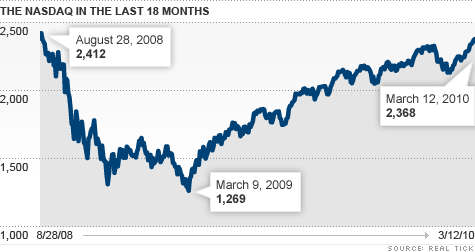
NEW YORK (CNNMoney.com) -- Stocks have ended four of the last five weeks higher, leaving the Nasdaq and S&P 500 at 18-month highs and the Dow industrials not far from such levels.
Since bottoming at a 6-year low on March 9 of last year, the Nasdaq has gained 87%. Since bottoming at a 12-year low on the same day, the S&P 500 has gained 70% and the Dow has gained 62%.
But the majority of those gains happened last year and another leg up for the market could prove elusive, at least for the time being. With just two weeks left in the first quarter, investors are set to wade through a period that's devoid of corporate profit reports and still fraught with worries about the outlook for the economy.
"We're in a volatile period right now," said Kevin Mahn, portfolio manager at Hennion & Walsh. "2010 is going to be a transitional year and I think both stock market and economic growth will be muted."
Although stocks are up modestly, following 2009's big stock rally, it has been a challenging start to the year. So far, Wall Street has seen expectations for a robust recovery bat up against the reality of a still hard-hit labor market and housing sector, not to mention the fallout from huge U.S. and global deficits.
But some positives have also emerged, including last week's surprisingly strong retail sales report and indications that manufacturing is recovering. The push and pull between weaker and stronger reports has enabled stocks to eke out enough gains to get the major gauges back to levels not seen in 1-1/2 years. But the next push is likely to be a lot harder.
This week brings a series of reports on manufacturing, as well as the latest on the job market, the housing market and inflation. The Federal Reserve meets Tuesday to discuss interest rate policy and the outlook for the economy.
Federal Reserve: The bankers meet Tuesday and a decision on rates is expected to be announced at around 2:15 p.m. ET. The central bank is widely expected to hold the fed funds rate, a key overnight bank lending rate, steady at historic lows near zero and to indicate that it will continue to do so for the foreseeable future.
The Fed opted to boost the discount rate, the emergency bank lending rate, by a quarter-percentage point to 0.75% last month, in a rare move made in between meetings. However, the move was seen as largely symbolic, as the discount window is rarely used.
The fed funds rate has stood at levels near zero since December 2008. A sustained period of historically low interest rates combined with the infusion of trillions of dollars into the financial system eased the blow of the recession over the last year. The stimulus also helped drive the stock rally during this time.
But now the Fed is walking a tightrope between remaining accommodating for too long and driving up inflation and moving too fast and choking off growth, said Hank Smith, chief investment officer at Haverford Investments.
"The Fed is going to err on the side of being accommodating for too long," said Smith. "Thanks to the lack of inflationary pressures they can afford to."
With no policy change, investors will be more focused on the Fed's statement Tuesday, in particular what it hints about when the bank plans to take its foot off the gas pedal.
"They are going to continue unwinding the quantitative programs that are in place," said Smith, "but they aren't going to start raising rates until well into the second half of the year and they aren't likely to start indicating that now."
Monday: The Federal Reserve's February reading on factory output is due shortly before the start of trading. Industrial output is expected to have held steady after rising 0.9% in the previous month, according to a consensus of economists surveyed by Briefing.com. Capacity utilization is expected to have fallen to 72.3% from 72.6% in the previous month.
The Empire Manufacturing survey is due before the start of trading. The regional reading on manufacturing is expected to have dipped to 23.45 in March from 24.91 in February.
Tuesday: New home construction is expected to have dipped slightly in February, with housing permits falling to a 587,000 unit annualized rate from a 591,000 unit annualized rate in the previous month.
The Commerce Department report is also expected to show that building permits, a measure of builder confidence, fell to a 614,000 unit annualized rate from a 622,000 unit rate in the previous month.
February import and export prices are also due in the morning.
Wednesday: The Producer Price index (PPI), a measure of wholesale inflation, is expected to have fallen 0.1% in February after rising 1.4% in the previous month. The so-called core PPI is expected to have risen 0.1% after rising 0.3% in January.
The weekly crude oil inventories report is also due in the morning.
Thursday: The Consumer Price Index (CPI) is expected to have risen 0.1% after rising 0.2% January. The so-called core CPI is expected to have risen 0.1% after rising 0.2% in January. The Labor Department report is due in the early morning.
The Leading Economic Indicators (LEI), from the Conference Board, is expected to have risen 0.2% in February after rising 0.3% in January.
The weekly jobless claims report is also due in the morning, along with the Philadelphia Fed index, a regional reading on manufacturing.
FedEx (FDX, Fortune 500) reports quarterly results before the start of trading. The company is expected to have earned 72 cents per share after earning 31 cents a year ago.
Friday: Friday brings the quadruple options expiration, a quarterly event in which stock index futures and options and individual stock futures and options all expire at the same time.
The event can lead to wild gyrations in prices in the underlying stocks and increased volatility in the broad market. However, the impact now tends to be pretty muted and spread throughout the week, rather than hitting in the last hour of the session Friday, as used to be the case. 




| Overnight Avg Rate | Latest | Change | Last Week |
|---|---|---|---|
| 30 yr fixed | 3.80% | 3.88% | |
| 15 yr fixed | 3.20% | 3.23% | |
| 5/1 ARM | 3.84% | 3.88% | |
| 30 yr refi | 3.82% | 3.93% | |
| 15 yr refi | 3.20% | 3.23% |
Today's featured rates:



| Index | Last | Change | % Change |
|---|---|---|---|
| Dow | 32,627.97 | -234.33 | -0.71% |
| Nasdaq | 13,215.24 | 99.07 | 0.76% |
| S&P 500 | 3,913.10 | -2.36 | -0.06% |
| Treasuries | 1.73 | 0.00 | 0.12% |
| Company | Price | Change | % Change |
|---|---|---|---|
| Ford Motor Co | 8.29 | 0.05 | 0.61% |
| Advanced Micro Devic... | 54.59 | 0.70 | 1.30% |
| Cisco Systems Inc | 47.49 | -2.44 | -4.89% |
| General Electric Co | 13.00 | -0.16 | -1.22% |
| Kraft Heinz Co | 27.84 | -2.20 | -7.32% |
|
Bankrupt toy retailer tells bankruptcy court it is looking at possibly reviving the Toys 'R' Us and Babies 'R' Us brands. More |
Land O'Lakes CEO Beth Ford charts her career path, from her first job to becoming the first openly gay CEO at a Fortune 500 company in an interview with CNN's Boss Files. More |
Honda and General Motors are creating a new generation of fully autonomous vehicles. More |
In 1998, Ntsiki Biyela won a scholarship to study wine making. Now she's about to launch her own brand. More |
Whether you hedge inflation or look for a return that outpaces inflation, here's how to prepare. More |



