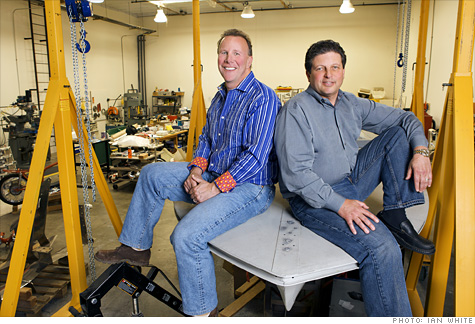
 Adam Grosser (left), with Warren Weiss, builds boats for fun and companies for profit.
FORTUNE -- Adam Grosser has what some might call a weird obsession with golden orb spiders. He totes around drawings of them on his MacBook Pro. He travels near and far to meet experts who have studied their ways. He joyously cites the unusual characteristics of the golden silk they weave. "It's three times stronger than steel," says Grosser, a venture capitalist in Silicon Valley, "and better able to repel water than existing synthetics." So what's the entrepreneurial opportunity? He's not quite sure, but he'll let you know when he figures it out.
Such whimsy is the norm these days at Foundation Capital, where Grosser is a partner. And why not? Foundation is spinning solid returns on its investments. At a time when venture performance has soured and institutional investors have lost confidence in the onetime masters of the universe, Foundation has the hot hand of the moment. Patient stakes in startups such as networking-gear maker Calix (CALX) and retirement fund administrator Financial Engines (FNGN) have resulted in recent IPOs, a rare occurrence since the onset of the financial crisis.
Moreover, Menlo Park, Calif.-based Foundation, which is 15 years old and manages about $2.5 billion, is poised for sizable wins from a bevy of refreshingly offbeat investments: Utility software and gear maker Silver Spring Networks is the most promising offering in the as-yet-disappointing clean-technology arena. Chegg, a college-textbook rental company, appears likely to replicate the success Foundation had with an early investment in DVD-rental dynamo Netflix (NFLX).
It's all rather exciting for these self-described mid-career, middle-aged technology veterans who aren't particularly well known outside the clubby world of Silicon Valley. Other investors display an alpha-dog swagger; Foundation's partners boast of their teamwork, including a preference for working in pairs. "We also don't embrace themes," adds Warren "Bunny" Weiss (it's a childhood nickname). "We embrace entrepreneurs and big markets."
Still, themes emerge, which is how Foundation became an early leader in backing startups that profit from energy efficiency. Shortly after the tech-stock crash, the firm analyzed research efforts in various industries, and discovered a dramatic underinvestment in electric utilities. Foundation quickly saw an opportunity to invest in an industry that hadn't been infiltrated by information technology.
Eight years ago Weiss came across a company in Milwaukee that would become Silver Spring. Other Valley firms were focused on creating biofuels, a classic supply-side approach to alternative energy. Silver Spring focused instead on demand. Today the company is a leading developer of so-called smart grid technology that helps utilities monitor customer usage. The data then help power companies predict problems, fix outages, and save energy. Foundation subsequently made a slew of similar investments, including EnerNOC (ENOC) (a public company that also sells demand-management systems to utilities), and two companies with consumer applications, eMeter and Control4.
Foundation revels in the path less traveled. Building-products companies Serious Materials and CalStar create alternative sources of sheetrock and Portland cement, respectively, both decades-old and energy-intensive products. TransMedics is pioneering a device that allows transplant surgeons to keep organs alive outside the body, improving presurgical organ-survival rates. In many cases Foundation is a startup's largest investor, often out of conviction but sometimes, as was the case for several years with Silver Spring, because no other firm would touch the investment. Foundation's conviction could pay off big: Silver Spring today is valued at more than $1 billion, and bankers expect it to go public soon -- unless it gets snapped up first by the likes of Cisco (CSCO, Fortune 500) or some other networking-oriented giant.
Having a string of hits, of course, will only embolden Foundation. Grosser, the partner with a thing for spiders, is leaving soon for a trip to Madagascar, the only place he knows where golden orb spiders are raised. He's not entirely convinced the trip will bear fruit -- or silk -- soon for Foundation's investors. "It's a good excuse to go someplace I've never been," he says. So long as he and his partners keep making money, they're not likely to have any trouble persuading their backers to come along for the ride. 



| Company | Price | Change | % Change |
|---|---|---|---|
| Ford Motor Co | 8.29 | 0.05 | 0.61% |
| Advanced Micro Devic... | 54.59 | 0.70 | 1.30% |
| Cisco Systems Inc | 47.49 | -2.44 | -4.89% |
| General Electric Co | 13.00 | -0.16 | -1.22% |
| Kraft Heinz Co | 27.84 | -2.20 | -7.32% |
| Index | Last | Change | % Change |
|---|---|---|---|
| Dow | 32,627.97 | -234.33 | -0.71% |
| Nasdaq | 13,215.24 | 99.07 | 0.76% |
| S&P 500 | 3,913.10 | -2.36 | -0.06% |
| Treasuries | 1.73 | 0.00 | 0.12% |
|
Bankrupt toy retailer tells bankruptcy court it is looking at possibly reviving the Toys 'R' Us and Babies 'R' Us brands. More |
Land O'Lakes CEO Beth Ford charts her career path, from her first job to becoming the first openly gay CEO at a Fortune 500 company in an interview with CNN's Boss Files. More |
Honda and General Motors are creating a new generation of fully autonomous vehicles. More |
In 1998, Ntsiki Biyela won a scholarship to study wine making. Now she's about to launch her own brand. More |
Whether you hedge inflation or look for a return that outpaces inflation, here's how to prepare. More |




