NEW YORK (CNNMoney.com) -- Cut the budget! That was the rallying cry for many candidates of both parties, but if you listened closely, you heard little in the way of specifics.
Enter the co-chairmen of President Obama's bipartisan deficit commission. On Wednesday, they recommended 58 ways to cut spending. And their cuts are downright specific.
The report from Erskine Bowles and Alan Simpson -- experienced Washington hands -- recommends reducing discretionary spending to 2010 levels in 2012, and then cutting discretionary spending by 1% a year through 2015.
After 2015, inflation-adjusted growth would be allowed.
Overall, Simpson and Bowles are recommending that total spending not exceed 22% of GDP initially, but no more than 21% eventually.
To show how Congress could hit those targets, Bowles and Simpson offered examples of cuts totaling $200 billion for the year 2015.
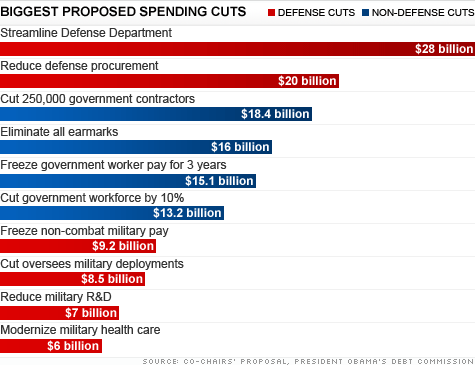
Here are their top 10 money-saving proposals, six of which come from the defense portion of the federal budget:
Streamline the Defense Department: In May, Defense Secretary Robert Gates announced a plan to cut defense spending and reallocate the money within defense. But Bowles and Simpson say that $28 billion in savings could be used to reduce the deficit.
Reduce defense procurement: The co-chairmen proposed cutting $20 billion in defense contracts. On the chopping block are two next-generation fighting machines: the V-22 Osprey and the Expeditionary Fighting Vehicle.
Cut 250,000 non-defense contractors: There are simply too many government contractors (2.4 million added between 2002 and 2005), according to Bowles and Simpson. Cutting 250,000 jobs would save an estimated $18.4 billion.
Eliminate all earmarks: Long the whipping boy of government spending, cutting these handpicked pork projects would save an estimated $16 billion.
Freeze pay for non-defense workers for 3 years: The wages of federal employees have continued to climb during the recession, despite the fact that private-sector wages have stalled. A three-year freeze on government pay would net $15.1 billion in savings, according to the co-chairmen.
Cut non-defense workforce by 10%: If the government hires only two workers for every three that leave their jobs, the federal workforce will decline by 200,000 by 2020, saving the government $13.2 billion.
Freeze non-combat military pay: Regular military pay is expected to grow by $9.2 billion from 2011 to 2015. The report recommends a three-year freeze at 2011 pay levels (excluding combat pay).
Cut overseas military deployments: Reducing the 150,000 military personnel on overseas deployment by one-third would save an estimated $8.5 billion. Both former Defense Secretary Donald Rumsfeld and National Security Adviser Jim Jones have supported similar proposals in the past.
Reduce military R&D: A 10% reduction in military research and development would save an estimated $7 billion. Bowles and Simpson argue the cut is consistent with the military's move away from major weapons system research.
Modernize military health care: Reforming the DOD's health care systems would save an estimated $6 billion. 






| Index | Last | Change | % Change |
|---|---|---|---|
| Dow | 32,627.97 | -234.33 | -0.71% |
| Nasdaq | 13,215.24 | 99.07 | 0.76% |
| S&P 500 | 3,913.10 | -2.36 | -0.06% |
| Treasuries | 1.73 | 0.00 | 0.12% |
| Company | Price | Change | % Change |
|---|---|---|---|
| Ford Motor Co | 8.29 | 0.05 | 0.61% |
| Advanced Micro Devic... | 54.59 | 0.70 | 1.30% |
| Cisco Systems Inc | 47.49 | -2.44 | -4.89% |
| General Electric Co | 13.00 | -0.16 | -1.22% |
| Kraft Heinz Co | 27.84 | -2.20 | -7.32% |
|
Bankrupt toy retailer tells bankruptcy court it is looking at possibly reviving the Toys 'R' Us and Babies 'R' Us brands. More |
Land O'Lakes CEO Beth Ford charts her career path, from her first job to becoming the first openly gay CEO at a Fortune 500 company in an interview with CNN's Boss Files. More |
Honda and General Motors are creating a new generation of fully autonomous vehicles. More |
In 1998, Ntsiki Biyela won a scholarship to study wine making. Now she's about to launch her own brand. More |
Whether you hedge inflation or look for a return that outpaces inflation, here's how to prepare. More |




