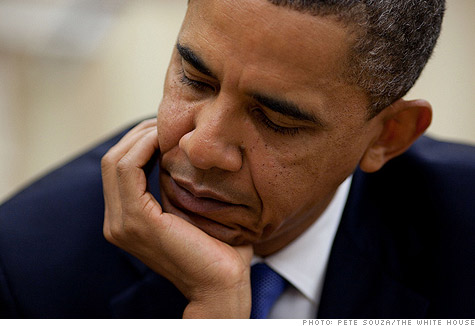
FORTUNE -- President Barack Obama sidestepped a gridlock in Mexico.Countries meeting in Cancún for the United Nations Framework Convention on Climate Change (UNFCC) want the United States to commit to do anything about climate change. But President Obama didn't attend the conference -- wisely, probably --since the political climate in the US would block any binding commitment to curb greenhouse gasses.
The UNFCC is a follow-up conference to the 1997 Kyoto protocol, which outlined greenhouse gas emission goals for 37 countries. The agreement expires in 2012. That's why now, global leaders are trying to figure out how to maintain the emissions targets outlined in Kyoto, or even make them more restrictive.
The Kyoto agreement exempted developing countries such as China, India and Brazil, the so called BRIC countries, from hard greenhouse gas emission targets -- the idea being that those countries needed cheap fossil fuels to industrialize. The US is the only developed nation that hasn't agreed to Kyoto. Hence President Obama's decision to opt out of Cancún. There's just not much he could do there to further emissions targets on an agreement that the United States refuses to ratify.
Not that the US is anti-green energy, says Eric Silverman, a partner at law firm Milbank Tweed's Global Project Finance Group who specializes in energy project finance.
"While its true that the US hasn't played the leading role that some countries would like it to play, it's also true that there's a lot of progress being made in the US, although it's certainly not as dramatic or as rapid as some environmentalists would like to see."
For example, ten states in the Northeast and Mid-Atlantic US agreed last year to the Regional Greenhouse Gas Initiative, which set a regional cap on carbon emissions over the next ten years. California passed its own Global Warming Solutions Act in 2006, and defeated a proposition to suspend it this past November.
The stalemate over cap and trade
At the federal level, even as the Obama administration has backed away from pushing carbon cap and trade, it has supported a movement towards clean energy. On Tuesday, Secretary of Energy Steven Chu announced at a Nuclear Energy Summit that the US should develop nuclear power facilities, probably in the hopes to draw Republican support for clean energy initiatives.
So why doesn't the US put its money where its mouth is on a global platform and join Kyoto? Because despite the President's own beliefs about climate change, Silverman says, the Senate would never agree to ratify Obama's signature to the treaty, especially after rejecting it in 1997 and watching President Bush pull away even tacit support for its terms in 2001.
In this economy, it's hard to ask taxpayers to subsidize clean energy, Silverman adds, and the results of the Republican swing during this year's midterm election can be seen as a backlash against greater government control.
"There's a strong sense of people trying to reduce taxes and make government programs smaller," Silverman says. "That runs in direct conflict with environmentalist goals to put a cap on carbon emissions. You couldn't have two more opposite philosophies or ideals."
Which creates a stalemate. The United States won't pass any federal regulation on greenhouse gases, so it can't make much of a difference at Cancún. But that means that China and other countries with emerging markets won't move on carbon emissions either.
"You have people in China and India who basically say, 'we can't do it because we can't afford it,' and they're the richest of the emerging countries," Silverman says. "Then you have people in the US who say we can't afford it either-this will make us uncompetitive with industrial production in the BRIC countries. I think there's no solution."
China and the United States are the top two emitters of greenhouse gasses. In 2008, the US released about 5,800 million metric tons of carbon dioxide and China emitted over 6,500 million metric tons, according to the Energy Information Administration. Even though China is also leading the development of renewables, it won't sign a binding contract to lower greenhouse gas emissions before the United States. If it did, China would have to burn less fossil fuels, which could put its industrial industries at a disadvantage.
"Progress toward getting some kind of global agreement would be served substantially just by the US doing anything," says Shayle Kann, an energy analyst with Greentech Media global research. "It would certainly be a push in the right direction, even if it wouldn't be a straw that broke the camels' back."
Kann says that developing countries have always wanted a global agreement. That's partially because a global agreement would target the world's top emitters, and probably wouldn't mandate hard emissions targets for countries that, relatively, don't generate much carbon. A global agreement would also enhance incentives for developing countries along the lines of the fund created during the Copenhagen Climate Council last year. Developed countries pledged to donate $100 billion a year by 2020 to fund alternative energy in developing countries.
"The world over, everyone is invested in renewable energy," Kann says.
But until the United States enters a global, binding agreement, there will be slow and piecemeal progress towards cutting carbon emissions, says Silverman-not just in America, but all over the world.
No one goes until we go. And from the looks of it, we're not budging. 





| Company | Price | Change | % Change |
|---|---|---|---|
| Ford Motor Co | 8.29 | 0.05 | 0.61% |
| Advanced Micro Devic... | 54.59 | 0.70 | 1.30% |
| Cisco Systems Inc | 47.49 | -2.44 | -4.89% |
| General Electric Co | 13.00 | -0.16 | -1.22% |
| Kraft Heinz Co | 27.84 | -2.20 | -7.32% |
| Index | Last | Change | % Change |
|---|---|---|---|
| Dow | 32,627.97 | -234.33 | -0.71% |
| Nasdaq | 13,215.24 | 99.07 | 0.76% |
| S&P 500 | 3,913.10 | -2.36 | -0.06% |
| Treasuries | 1.73 | 0.00 | 0.12% |
|
Bankrupt toy retailer tells bankruptcy court it is looking at possibly reviving the Toys 'R' Us and Babies 'R' Us brands. More |
Land O'Lakes CEO Beth Ford charts her career path, from her first job to becoming the first openly gay CEO at a Fortune 500 company in an interview with CNN's Boss Files. More |
Honda and General Motors are creating a new generation of fully autonomous vehicles. More |
In 1998, Ntsiki Biyela won a scholarship to study wine making. Now she's about to launch her own brand. More |
Whether you hedge inflation or look for a return that outpaces inflation, here's how to prepare. More |




