NEW YORK (CNNMoney) -- In the run-up to President Obama's State of the Union address next Tuesday, Republicans are turning up the volume on their pledges to cut spending.
On Thursday, the House Republican Study Committee -- which includes some of the party's most conservative members -- introduced a bill that the committee said would reduce spending by $2.5 trillion over a decade.
The bill takes the money primarily from non-defense discretionary spending, which constitutes 19% of the budget. It would keep spending at 2006 levels, starting next year, and proposes $330 billion in cuts to more than 100 programs over ten years.
It sounds more straightforward than it would be in reality. For instance, a summary of the proposal does not make clear what would be cut to establish 2006 levels. Would the cuts be across the board or more targeted?
And more broadly, it's not clear whether the bill would make a significant dent in the national debt. By excluding defense and entitlement spending from cuts, the bill fails to address the biggest pieces of the federal budget.
RSC Chairman Jim Jordan of Ohio characterized the bill as a "good first step" toward a more fiscally sustainable path. But he also said that "everything needs to be on the table" in discussions about how to curb U.S. debt, including potential cuts to defense -- a position conservatives typically reject.
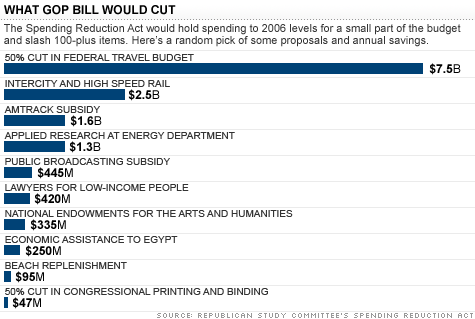
Among the biggest items the legislation would eliminate and the annual savings from each:
Funding for a host of smaller programs would also be cut, including the Corporation for Public Broadcasting ($445 million a year); as well as both the National Endowment for the Arts and the National Endowment for the Humanities (a combined $335 million).
Among the spending reductions called for: the federal travel budget would be cut in half ($7.5 billion a year) as would the funding for congressional printing and binding ($47 million a year).
It is not clear how much broad Republican support the Spending Reduction Act will attract. Nor is it clear if the Republican leadership will champion any of the bill's proposals.
Republicans are vowing to use the looming need to raise the country's debt limit to extract spending cuts in negotiations with Democrats.
A spokesman for House Speaker John Boehner said "we appreciate every member's input" in the Republicans' quest to reduce spending to "pre-bailout, pre-stimulus levels."
The bill comes on the heels of smaller bill introduced last week by Rep. Kevin Brady, a Republican from Texas. That legislation would cut $153 billion from the federal budget over five years and includes many spending reductions proposed by President Obama's bipartisan debt commission.
Meanwhile, next Tuesday, the House will vote on a resolution that reinforces the budget committee chairman's power under newly passed House rules. Those rules let Budget Chairman Paul Ryan pick a top-line spending number for the federal budget that would apply to the second-half of fiscal year 2011.
Currently there is no new 2011 federal budget in place, but there is a temporary spending measure that extends 2010 levels for government agencies until March 4 -- midway through the fiscal year. 




| Index | Last | Change | % Change |
|---|---|---|---|
| Dow | 32,627.97 | -234.33 | -0.71% |
| Nasdaq | 13,215.24 | 99.07 | 0.76% |
| S&P 500 | 3,913.10 | -2.36 | -0.06% |
| Treasuries | 1.73 | 0.00 | 0.12% |
| Company | Price | Change | % Change |
|---|---|---|---|
| Ford Motor Co | 8.29 | 0.05 | 0.61% |
| Advanced Micro Devic... | 54.59 | 0.70 | 1.30% |
| Cisco Systems Inc | 47.49 | -2.44 | -4.89% |
| General Electric Co | 13.00 | -0.16 | -1.22% |
| Kraft Heinz Co | 27.84 | -2.20 | -7.32% |
|
Bankrupt toy retailer tells bankruptcy court it is looking at possibly reviving the Toys 'R' Us and Babies 'R' Us brands. More |
Land O'Lakes CEO Beth Ford charts her career path, from her first job to becoming the first openly gay CEO at a Fortune 500 company in an interview with CNN's Boss Files. More |
Honda and General Motors are creating a new generation of fully autonomous vehicles. More |
In 1998, Ntsiki Biyela won a scholarship to study wine making. Now she's about to launch her own brand. More |
Whether you hedge inflation or look for a return that outpaces inflation, here's how to prepare. More |




