NEW YORK (CNNMoney) -- Android is now the most-used smartphone operating system in the United States -- a stunning race to the top from a platform that didn't exist just 27 months ago.
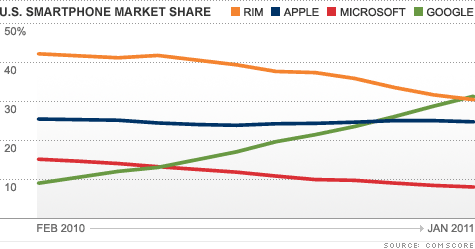
Nearly one third, or 31.2%, of U.S. smartphones ran Google's (GOOG, Fortune 500) Android OS in January, according to a study released Monday by comScore. That outpaced the 30.4% of American smartphone owners who use BlackBerry devices, which are made by Research in Motion (RIMM).
The meteoric rise of Android began in late October 2008, when HTC's G1 phone went on sale for T-Mobile users. The platform really started to take off when the Motorola (MMI) Droid went on sale in November 2009. Google's mobile OS began 2010 with just a 7% share of the smartphone market, but Android has grown by an astounding two percentage points each month since, on average.
Android was in fourth place as recently as May 2010, but it outpaced Microsoft's Windows Mobile in June. In November, Android overtook Apple's (AAPL, Fortune 500) iOS, which runs on the iPhone, iPod Touch and iPad. It finally conquered the mighty BlackBerry OS in the first month of this year -- vanquishing an operating system that had more than a 42% share of the U.S. smartphone market a year ago.
Now, 350,000 Android devices are activated each day, and there are more than 170 smartphones and tablets running Android, according to the search giant.
Much of Android's success can be chalked up to Google's open business model: Google licenses the mobile OS for free, allowing handset manufacturers to load the ready-made software onto their phones instead of paying a team of engineers to develop a proprietary platform. They can customize it as much as they like, too.
LG, HTC, Samsung, Motorola, and dozens of other handset makers have jumped onto the Android bandwagon -- and the ability to focus exclusively on the hardware allowed device manufacturers to start bringing phones to market much more quickly. In fact, the time it takes smartphones to go from concept to store shelves has been halved thanks to "Android's law."
Worldwide, Android beat BlackBerry last year, but it still trails Nokia's Symbian OS, according to Gartner. Nokia (NOK) recently announced that it would ditch Symbian, which has been rapidly losing market share, for Microsoft's (MSFT, Fortune 500) Windows Phone OS.
Nokia CEO Stephen Elop acknowledged that he had considered partnering with Google, but he said that Windows Phone offered more differentiation amid a sea of new Android devices. 


| Index | Last | Change | % Change |
|---|---|---|---|
| Dow | 32,627.97 | -234.33 | -0.71% |
| Nasdaq | 13,215.24 | 99.07 | 0.76% |
| S&P 500 | 3,913.10 | -2.36 | -0.06% |
| Treasuries | 1.73 | 0.00 | 0.12% |
| Company | Price | Change | % Change |
|---|---|---|---|
| Ford Motor Co | 8.29 | 0.05 | 0.61% |
| Advanced Micro Devic... | 54.59 | 0.70 | 1.30% |
| Cisco Systems Inc | 47.49 | -2.44 | -4.89% |
| General Electric Co | 13.00 | -0.16 | -1.22% |
| Kraft Heinz Co | 27.84 | -2.20 | -7.32% |
|
Bankrupt toy retailer tells bankruptcy court it is looking at possibly reviving the Toys 'R' Us and Babies 'R' Us brands. More |
Land O'Lakes CEO Beth Ford charts her career path, from her first job to becoming the first openly gay CEO at a Fortune 500 company in an interview with CNN's Boss Files. More |
Honda and General Motors are creating a new generation of fully autonomous vehicles. More |
In 1998, Ntsiki Biyela won a scholarship to study wine making. Now she's about to launch her own brand. More |
Whether you hedge inflation or look for a return that outpaces inflation, here's how to prepare. More |




