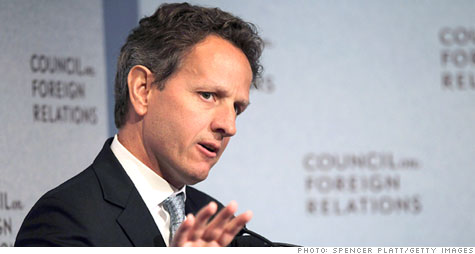
 Treasury Secretary Timothy Geithner has urged lawmakers to raise the country's debt ceiling by early summer, preferably sooner.
NEW YORK (CNNMoney) -- Some Republican lawmakers are challenging Treasury Secretary Tim Geithner's warnings about the grave consequences of not raising the country's debt ceiling.
Geithner has said the country would risk default if Congress doesn't raise the country's legal borrowing limit by July 8.
Just pay the interest on the debt to bondholders -- that'll prevent default, Geithner's critics say.
Indeed, the Treasury Department takes in about $177 billion a month on average. And interest on public debt only costs $19 billion.
That's good. He can pay the interest. But it's hardly the whole story.
Average monthly spending -- minus interest -- is $276 billion. That means Geithner will be short $118 billion every month to pay all the bills the country has incurred.
But just talking "averages" can be deceiving, because monthly spending and revenue are "bumpy month to month," said former Congressional Budget Office acting director Donald Marron.
Translation: There may be times when Geithner comes up far shorter than $118 billion.
Either way, he would be put in the completely ridiculous position of having to prioritize who besides bondholders should get paid first and which federal contractors and programs would be effectively issued I.O.U.s payable when Congress comes to its senses and raises the debt ceiling.
That could mean deferring payments to Social Security beneficiaries, Medicare doctors, weapons vendors or taxpayers expecting refunds.
It's a ridiculous position to put any treasury secretary in because the debt ceiling is not a cause of rising debt or a "license to spend more" -- as some incorrectly allege. It simply authorizes Treasury to pay the bills Congress chose to incur when it passed years worth of spending increases and tax cuts that are now law.
"The decisions that create the need to borrow are made separately from -- and generally earlier than -- the decision about the debt limit," according to a report from the Government Accountability Office.
In any case, paying bondholders first while shirking other obligations wouldn't necessarily protect the country from the perception that it's in default.
Geithner himself equated the situation to a homeowner who pays his mortgage but puts off his car loan, credit cards, insurance premiums and utilities. Even though the mortgage would be taken care of, the homeowner's credit could still be damaged.
Since it's never happened before, it's not clear to anyone -- no matter what they say -- how markets, businesses or average Joes would view the country if it has to indefinitely stiff contractors or government programs.
What is clear, however, is that the situation wouldn't exactly bolster the United States' reputation.
"There's a hard-to-make-tangible loss of face for the United States. It's embarrassing," Marron said.
The long-term debt situation absolutely needs to be addressed. But it's a mystery why lawmakers -- so all of a sudden flummoxed about the problem they helped create -- would actually want to risk borrowing yet more trouble for the country just to make the political point that they're really serious about fiscal responsibility.
Especially since it's their job to responsibly manage the country's books all the time, not just when they create the threat of a crisis that, handled badly, could hurt the country's financing and credit reputation. 







| Index | Last | Change | % Change |
|---|---|---|---|
| Dow | 32,627.97 | -234.33 | -0.71% |
| Nasdaq | 13,215.24 | 99.07 | 0.76% |
| S&P 500 | 3,913.10 | -2.36 | -0.06% |
| Treasuries | 1.73 | 0.00 | 0.12% |
| Company | Price | Change | % Change |
|---|---|---|---|
| Ford Motor Co | 8.29 | 0.05 | 0.61% |
| Advanced Micro Devic... | 54.59 | 0.70 | 1.30% |
| Cisco Systems Inc | 47.49 | -2.44 | -4.89% |
| General Electric Co | 13.00 | -0.16 | -1.22% |
| Kraft Heinz Co | 27.84 | -2.20 | -7.32% |
|
Bankrupt toy retailer tells bankruptcy court it is looking at possibly reviving the Toys 'R' Us and Babies 'R' Us brands. More |
Land O'Lakes CEO Beth Ford charts her career path, from her first job to becoming the first openly gay CEO at a Fortune 500 company in an interview with CNN's Boss Files. More |
Honda and General Motors are creating a new generation of fully autonomous vehicles. More |
In 1998, Ntsiki Biyela won a scholarship to study wine making. Now she's about to launch her own brand. More |
Whether you hedge inflation or look for a return that outpaces inflation, here's how to prepare. More |




