CNNMoney.com
Companies Economy International Corrections Pre-market trading After-hours trading Winners/losers/actives Bonds Currencies Commodities Money Magazine Retirement Mutual Funds Taxes Ask the Expert Money 101 Autos Loan Center Best Places to Live Calculators Mortgage Rates Personal tech Big Tech blog Techland blog Sectors and stocks Fortune 500 techs Tech Talk 100 best places to launch Ultimate resource guide Small biz makeovers FSB 100 Ask & Answer Fortune 500 Technology Investing Management Rankings Main Create portfolio Edit portfolio Create Alerts Edit Alerts

Make your money last

You're working and you're investing. As retirement gets closer to reality, you'll need a plan for turning all your savings into security - so you can really enjoy the next phase of your life.

Invest for growth
Invest for growth
To keep inflation from sapping your purchasing power over the course of retirement, you need to keep your savings growing at a decent pace. The surest way to do that is to invest a portion of your portfolio in stocks.

Stocks offer another advantage. Because they tend to deliver the biggest long-term returns, owning them can help you maintain higher account balances than you would otherwise have, even as you're drawing money from your savings. That gives you a larger cushion for unexpected expenses - whether it's a new roof or a big health-care bill.

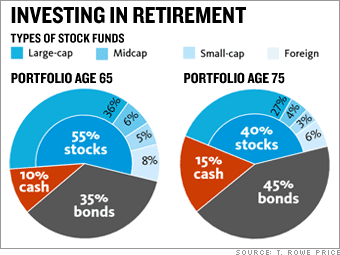
How much of your savings should you devote to stocks? The idea is to have enough to get the benefits of stocks' higher returns, but not so much that a market slide would so decimate your savings that your standard of living falls.

Generally, you should have around 55% of your savings in stocks at age 65. You can then gradually scale back that percentage to give yourself more protection from market turbulence as you age (see the model portfolios above).

Don't forget, though, that these are just guidelines. If you've got enough saved that a drop in the stock market won't have much impact on your lifestyle, you can hold a larger equity stake. But if a market reversal would deplete your portfolio, you'll want to be more conservative.

Remember too, that you can't afford to wimp out. Playing it too safe is actually dangerous: You may not be able to get the income you need for as long as you need it.

1 2 3 4
4 steps for making sure your portfolio is set up correctly. (more)
If you can say yes to these four questions, then you're on the right track. (more)
© 2008 Cable News Network. A Time Warner Company. All Rights Reserved. Terms under which this service is provided to you. Privacy Policy
Copyright © 2008 BigCharts.com Inc. All rights reserved. Please see our Terms of Use.
MarketWatch, the MarketWatch logo, and BigCharts are registered trademarks of MarketWatch, Inc.
Intraday data delayed 15 minutes for Nasdaq, and 20 minutes for other exchanges. All Times are ET.
Intraday data provided by Interactive Data Real-Time Services and subject to the Terms of Use.
Historical, current end-of-day data, and splits data provided by Interactive Data Pricing and Reference Data.
Fundamental data provided by Hemscott.
SEC Filings data provided by Edgar Online Inc..
Earnings data provided by FactSet CallStreet, LLC.