These days, unfortunately, company pensions are going the way of the Hula Hoop. But if you feel you need more assured income than you'll get from Social Security alone, you can create your own pension.
How? Buy what is known as a lifetime immediate annuity (a.k.a. an income or payout annuity). The premise is simple. You turn over a lump sum of cash to an investment firm or insurer, which in turn promises to send you a monthly check for a fixed amount each month.
The size of that check depends on your age, the level of interest rates, how much you invest and the payment option you select. You can choose, for example, to get monthly income for as long as you're alive, or for as long as you or your spouse is.
Whatever option you settle on, the main payoff of an annuity is the peace of mind in knowing that whether the markets go up or down, your check will arrive each and every month.
Now, you don't want to put all of your money in an annuity. For one thing, that fixed monthly amount will lose purchasing power over the course of your retirement. And once you start receiving checks, you typically lose access to the money you invested.
But by putting a portion of your savings into an immediate annuity and investing the rest in a diversified portfolio of stock and bond mutual funds, you get the best of both worlds. The annuity gives you steady income for the rest of your life. And the mutual fund portfolio gives you long-term growth.
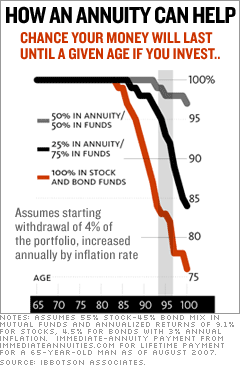
The combination of an annuity and mutual funds also improves the odds that your nest egg will last as long as you do.
How much should you put into an immediate annuity? That depends on how much assurance you want. As the graph to above shows, devoting 25% of your savings to an immediate annuity lowers your odds of running out of money by age 95 to less than 10%. Putting half your money in an immediate annuity would lower the odds even more, but you'd have less of your savings available. A good strategy is to initially put 25% of your money into an immediate annuity. If it turns out that you want more guaranteed income, you can always buy another later on.
One caveat, though. There are a lot of products and services out there, including other types of annuities, that promise lifetime income but come with lofty expenses.
Avoid them and opt for a plain, simple immediate annuity instead. After all, your goal is to turn your hard-earned savings into spending cash for your retirement, not fritter the money away on fees that will make a sales rep's retirement better.