
CNNMoney.com
Companies Economy International Corrections Pre-market Trading After-hours Trading Winners/Losers/Actives Bonds Currencies Commodities World Markets Money Magazine Real Estate Taxes Jobs Ask the Expert Money 101 Autos Mutual Funds The Help Desk Loan Center Best Places to Live Ask the Expert Ultimate Guide to Retirement Retirement Calculators Best Funds Best Places to Retire Fortune Brainstorm Tech Apple 2.0 Blog Big Tech Blog Sectors and Stocks Tech Talk Resource Guide Small Business Makeovers Questions & Answers Small Business Video 100 Best Places to Launch FSB 100 Fortune Small Business Fortune 500 Brainstorm Tech Investing Management C-Suite Rankings Main Create Portfolio Edit Portfolio Create Alerts Edit Alerts

Retire without taxes

Only one savings plan gives you the chance to free yourself from taxes in retirement. Are you making the most of it?

8 of 12
BACKNEXT
8. How do taxes work with Roth conversions?
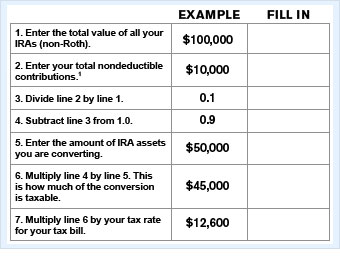
You may encounter more than a few sticky tax challenges when you convert. The first is how you'll pay the tax bill. You could use some of the IRA or 401(k) balance, but a conversion is more likely to pay off if you foot the bill with outside funds. Indeed, if you're under 591/2, you'll pay a 10% early-withdrawal penalty on the funds you tap to pay the taxes, eroding the benefits of making the swap.

You also need to think about what converting will do to your overall income tax bill. Even though the amount you convert doesn't affect your eligibility (if your AGI is $97,000 and you convert a $20,000 IRA, that doesn't push you over the $100,000 cap), it's considered taxable income. So a large 401(k) or IRA could nudge you into a higher bracket. In that case, convert smaller amounts over a few years or wait until you're in a lower bracket.

Finally, if you've ever opened a nondeductible IRA - or rolled a 401(k) with after-tax contributions into an IRA - you might think you could avoid taxes by converting only those after-tax dollars. Nice try, but you can't cherrypick funds. When you move just a piece of your IRA money into a Roth, for tax purposes the amount you convert is considered to have the same blend of pretax and after-tax dollars as all of your non-Roth IRAs. That could leave you with a complicated tax bill if you are converting just a portion of your IRA funds. You can use the worksheet to figure it out.

NEXT: What if I convert and then the market tanks?
Last updated September 16 2008: 11:34 AM ET
Source: Money research.
Example assumes 28% tax bracket. 1Include after-tax contributions to your 401(k) if you've rolled those contributions into any IRAs.
More Galleries
The future of car safety is here New, groundbreaking features can alert you to danger before you even know it's there. But added safety comes at added cost. More
Best digital camera bargains Capture holiday memories with these snazzy shooters - and still have money left for the turkey. More

Special Offer
© 2009 Cable News Network. A Time Warner Company. All Rights Reserved. Terms under which this service is provided to you. Privacy Policy
Copyright © 2009 BigCharts.com Inc. All rights reserved. Please see our Terms of Use.
MarketWatch, the MarketWatch logo, and BigCharts are registered trademarks of MarketWatch, Inc.
Intraday data provided by Interactive Data Real-Time Services and subject to the Terms of Use.
Intraday data is at least 20-minutes delayed. All times are ET.
Historical, current end-of-day data, and splits data provided by Interactive Data Pricing and Reference Data.
Fundamental data provided by Morningstar, Inc..
SEC Filings data provided by Edgar Online Inc..
Earnings data provided by FactSet CallStreet, LLC.