
CNNMoney.com
Companies Economy International Corrections Pre-market Trading After-hours Trading Winners/Losers/Actives Bonds Currencies Commodities World Markets Money Magazine Real Estate Taxes Jobs Ask the Expert Money 101 Autos Mutual Funds The Help Desk Loan Center Best Places to Live Ask the Expert Ultimate Guide to Retirement Retirement Calculators Best Funds Best Places to Retire Fortune Brainstorm Tech Apple 2.0 Blog Big Tech Blog Sectors and Stocks Tech Talk Resource Guide Small Business Makeovers Questions & Answers Small Business Video 100 Best Places to Launch FSB 100 Fortune Small Business Fortune 500 Brainstorm Tech Investing Management C-Suite Rankings Main Create Portfolio Edit Portfolio Create Alerts Edit Alerts
5 of 8
BACKNEXT
Oct. 9 - Volatility spikes after Treasury flip-flops
Dow closed at: 8,579.19
Change in points: -678.91
Percentage change: -7.33%

The Dow fell 2,400 points, or 22%, in the eight sessions spanning Oct. 1 to Oct. 10 - a drop not seen since the 1930s.

Thursday, Oct. 9 was the worst in the eight-day slide. Investors' fears about the ongoing credit crisis mounted after the Treasury Department said that it would purchase equity stakes in banks.

Announced just a week after Congress approved the $700 billion bailout plan, the plan marked a change from Treasury's initial intent, which was to buy up mortgage-backed securities from banks. While Treasury didn't rule out buying up banks' "toxic assets" (at that point, at least), it decided to focus its efforts on the equity-stake purchases. The market shunned Treasury's strategy shift.

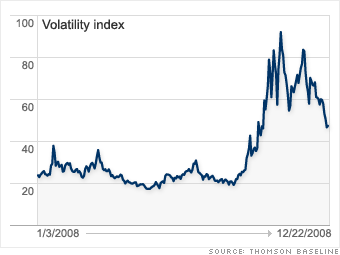
The Chicago Board Options Exchange volatility index, a key measure of investor fear, rose as high as 64 on Oct. 9, the first time the measure ever rose above 60. Later in the month, the index would soar to nearly 90 before falling in the next few months back below 50 as the government's bailout actions took hold.

The so-called VIX typically trades at around 15-20, and never rose above 30 before this year. The index erupted when the credit crisis hit in mid-September and is still running at double its typical level.

NEXT: Sep. 15 - Lehman collapses, credit crisis begins
Last updated December 29 2008: 2:39 PM ET
More Galleries
Holiday gifts for the yoga nut These 7 small brands are helping fuel a booming yoga industry. More
Best of the L.A. Auto Show Fuel economy is the name of the game in Southern California. More
Are things really getting better? Last quarter, the economy grew by the largest amount since the summer of 2007, but there are signs that things are still getting worse. More

Special Offer
© 2009 Cable News Network. A Time Warner Company. All Rights Reserved. Terms under which this service is provided to you. Privacy Policy
Copyright © 2009 BigCharts.com Inc. All rights reserved. Please see our Terms of Use.
MarketWatch, the MarketWatch logo, and BigCharts are registered trademarks of MarketWatch, Inc.
Intraday data provided by Interactive Data Real-Time Services and subject to the Terms of Use.
Intraday data is at least 20-minutes delayed. All times are ET.
Historical, current end-of-day data, and splits data provided by Interactive Data Pricing and Reference Data.
Fundamental data provided by Morningstar, Inc..
SEC Filings data provided by Edgar Online Inc..
Earnings data provided by FactSet CallStreet, LLC.